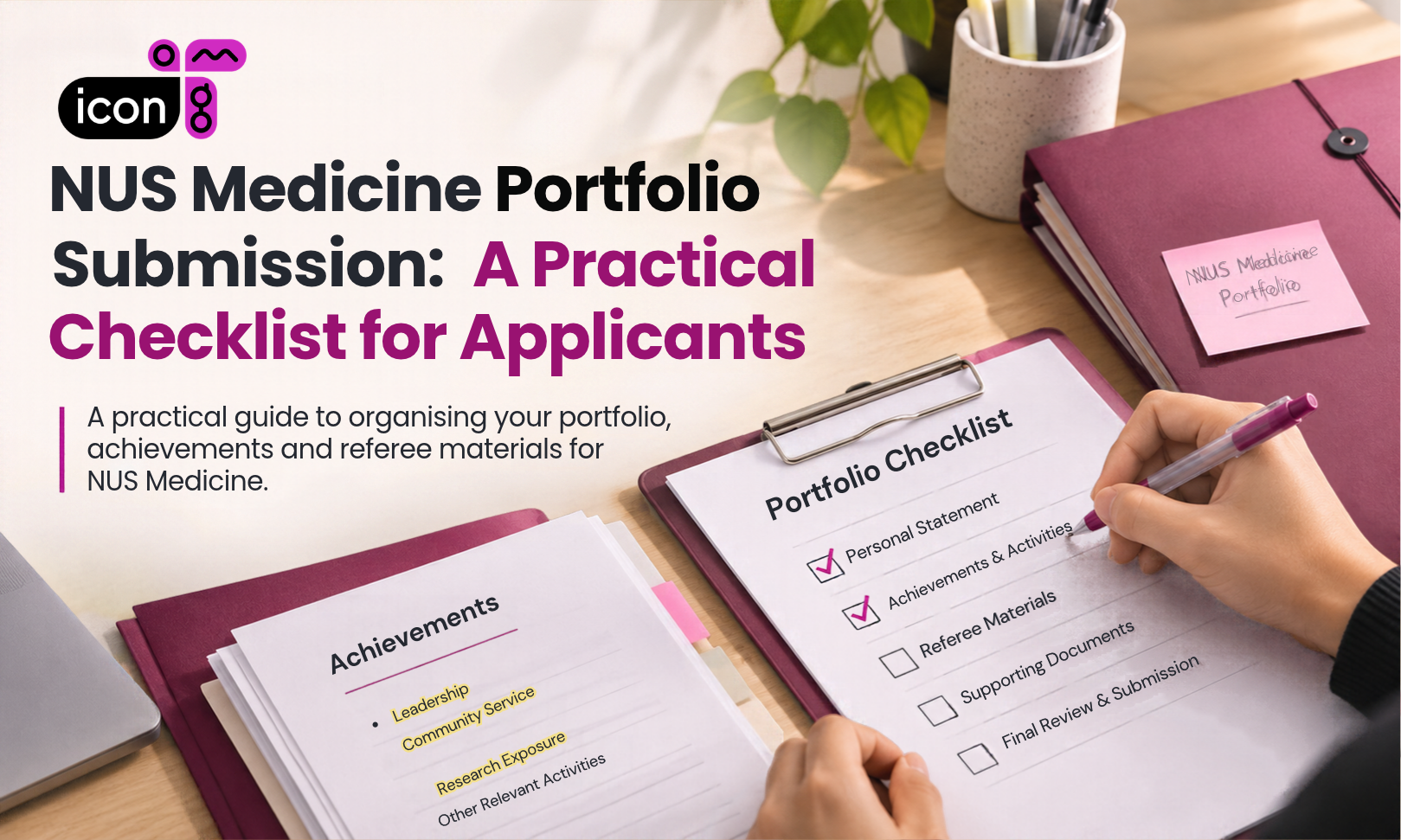
Preparing your NUS Medicine portfolio involves more than writing a personal statement. You need to coordinate your achievements, school testimonial and two referees — all through a separate submission process with its own deadline.
For the 2027 admissions cycle, NUS Medicine requires applicants to submit a personal statement, a list of achievements, an official school testimonial and two referee reports. Applicants using the Excellence Beyond Academics Scheme (EBAS) may also submit additional supporting documents.
This guide focuses specifically on the NUS Medicine portfolio submission process: what belongs in the portfolio, how to organize your achievements, what to prepare for your referees and what to check before you click submit.
For a broader overview of academic requirements and the overall application process, see Icon Education’s How to get into NUS Medicine in 2027.
NUS Medicine Portfolio 2027: At a Glance
| Item | 2027 requirement |
|---|---|
| Personal Statement | Maximum 500 words |
| Achievements | Top 10 activities or achievements from the past 3–4 years |
| Official Testimonial | From your JC, Polytechnic or high school |
| Referees | 2 referees who know you well and are not related to you |
| Standard Scheme | 28 January–19 March 2027, 11:00 AM SGT |
| EBAS | 28 January–9 March 2027, 11:00 AM SGT |
| Submission portal | Separate NUS Medicine Admissions Portal |
The Medicine portfolio is Step 2 of the application process. Applicants must also complete Step 1 through the main NUS Office of Admissions application. NUS states that applicants who fail to submit the Medicine portfolio will not be considered for Medicine.
What Belongs in the NUS Medicine Portfolio?
The portfolio has four core components, with additional supporting documents available for EBAS applicants.
| Portfolio component | Official NUS requirement | Practical preparation – Icon advice |
|---|---|---|
| Personal Statement | Maximum 500 words | Prepare a final proofread version that clearly reflects the experiences shaping your motivation and values |
| List of Achievements | Top 10 achievements and activities from the past 3–4 years | Collect dates, roles, organizations, achievements and short descriptions before entering the portal |
| Official Testimonial | Official testimonial from your JC, Polytechnic or high school | Check early whether your school has the final document available |
| Referee Reports | 2 referees who know you well and are not related to you | Confirm their willingness and correct contact details well before submission |
| Supporting Documents | Available for EBAS applicants | Include only relevant material that genuinely supports your EBAS application |
NUS states that the Medicine personal statement is separate from the five mandatory short-answer questions in the main NUS application. Those questions apply when you are applying to other NUS courses, while applicants applying only for Medicine are not required to provide substantive responses to them.
If you need help specifically with the statement itself, Icon Education’s Writing Your Med School Personal Statement for NUS and NTU covers narrative, reflection and structure in more detail.
Which Portfolio Route Should You Use?
Applicants may submit through either the Standard Scheme or EBAS, but not both.
Under the Standard Scheme, shortlisting is based purely on academic grades, and the portfolio is reviewed during the Focused Skills Assessment (FSA).
EBAS allows NUS Medicine to consider exceptional talent and achievement alongside academic performance. Applicants who have previously attended the NUS Medicine admissions assessment must reapply through EBAS if they wish to be considered again.
How Should You Select and Document Your Achievements?
NUS asks applicants to provide their top 10 achievements and activities from the past three to four years, including both academic and non-academic experiences. Applicants who have previously been shortlisted should highlight achievements gained since their previous interview.
The official NUS sample shows the information you should prepare for each activity:
| Field | What to prepare |
|---|---|
| Category | Select the category that best describes the activity |
| Start date | Month and year |
| End date | Month and year |
| Award / Achievement | Relevant result, award or recognition, where applicable |
| Appointment | Your role or position |
| Organization / Event | Name of the organization, program or event |
| Brief Description | A concise factual description of your involvement |
The NUS sample categories include Awards, Sports, School CCA, Community Involvement, Performance/Production, National Service, Research and Others.
Example: Turning One Experience into a Complete Entry
Imagine a fictional applicant who volunteered weekly with a community program supporting elderly residents.
Instead of beginning with a vague sentence such as:
“Volunteered with elderly residents and learned empathy.”
First organize the facts:
| Field | Fictional example |
|---|---|
| Category | Community Involvement |
| Start date | 03/25 |
| End date | 12/26 |
| Award / Achievement | — |
| Appointment | Volunteer |
| Organization / Event | Community Senior Support Program |
| Brief Description | Supported weekly social and digital-literacy activities for elderly participants and assisted coordinators during community sessions |
| Evidence to keep on hand – Icon advice only | Participation confirmation, certificate or supervisor contact, where available |
The important principle is accuracy before embellishment.
NUS does not state in its published achievement sample that applicants must upload supporting evidence for every activity. Keeping certificates, confirmations and contact details in a separate folder is therefore an Icon organizational recommendation, not an additional NUS submission requirement.
Doing so simply makes it easier to verify dates, roles and organization names before you submit.
Do Your Top 10 Activities All Need to Be Medicine-Related?
No.
NUS's own achievement categories cover areas such as sports, CCAs, community involvement, performance, National Service and research.
Rather than choosing an activity only because it appears “medical”, consider what each experience actually demonstrates about your involvement, contribution or development.
Your portfolio should also remain consistent with the rest of your application. If you discuss an activity in your personal statement, check that its dates, role and organization match the corresponding achievement entry.
What Should You Prepare for Your Referees?
NUS requires applicants to nominate two referees. They should know you well and must not be related to you. Once their details are entered into the portfolio system, NUS automatically sends each referee an email.
The sample referee report currently linked from the NUS Medicine portfolio page asks about areas such as:
- the referee's relationship with the applicant;
- character and weaknesses;
- conscientiousness;
- ability to handle stress;
- response to negative feedback;
- ethical judgment and integrity;
- ability to care for people from diverse backgrounds.
It also asks whether the referee would feel comfortable having the candidate look after them or their loved ones.
This makes referee selection important.
Icon advice: choose someone who has genuinely observed how you work, respond to challenges and interact with others.
A teacher, supervisor or mentor who knows you well may be able to provide more meaningful examples than someone with an impressive title but limited direct experience of you.
Before the portfolio window opens:
- confirm that each referee is willing to support you;
- verify their correct email address;
- tell them approximately when the NUS request will arrive;
- remind them of the context in which they worked with you.
You can provide a factual summary of relevant experiences, but the referee report should remain their own assessment.
A Note About the Current Referee Sample
As of 13 November 2026, the sample referee report linked from the NUS Medicine portfolio page is still labeled “2026”. It is useful for understanding the type of information referees may be asked to provide, but applicants should check the live NUS portfolio page and portal for any updated 2027 version before submission.
What Should You Check Before Submitting?
NUS states that once the Medicine portfolio has been submitted, changes cannot be made and the submission is treated as final.
Before submitting, run one final check:
| Final check | What to confirm |
|---|---|
| Application sequence | Step 1 through the NUS Office of Admissions has been completed |
| Submission route | You are applying through either Standard Scheme or EBAS, not both |
| Deadline | You are working toward the correct 2027 deadline and 11:00 AM SGT cut-off |
| Personal Statement | Maximum 500 words and final version |
| Achievements | No more than 10; dates, roles and organization names are accurate |
| Testimonial | Correct school document and properly certified if required |
| Referees | Two eligible referees with correct contact details |
| Cross-document consistency | Dates, titles and roles match across your portfolio and statement |
| EBAS materials | Supporting documents included only where relevant |
| Final preview | No incomplete fields, formatting problems or accidental draft text |
Do not treat the official deadline as your personal target submission time.
Documents, referee responses and technical issues can all create delays. Completing your own sections earlier gives you time to resolve problems without rushing.
Remember that the main NUS application and Medicine portfolio use separate portals: the main application is completed through the NUS Office of Admissions, while the portfolio is submitted through the NUS Medicine Admissions Portal.
NUS Medicine Portfolio Submission Tracker
Different parts of the portfolio depend on different people. A simple tracker can prevent one missing document or referee response from delaying your submission.
| Item | Owner | Suggested status |
|---|---|---|
| Main NUS application | Applicant | Not started / In progress / Submitted |
| 500-word personal statement | Applicant | Draft / Review / Final |
| Top 10 achievements | Applicant | Information collected / Entered / Checked |
| Official testimonial | School | Requested / Received / Verified |
| Referee 1 | Applicant + referee | Confirmed / Request sent / Completed |
| Referee 2 | Applicant + referee | Confirmed / Request sent / Completed |
| EBAS supporting documents, if applicable | Applicant | Selected / Verified / Uploaded |
| Final consistency check | Applicant | Pending / Complete |
| Medicine portfolio submission | Applicant | Pending / Submitted |
The most useful part of this tracker is seeing which items depend on someone else.
Your testimonial and referee reports should not become problems that you discover on the morning of the deadline.
Final Takeaway
A strong NUS Medicine portfolio submission is not about squeezing every activity you have ever completed into the application.
It is about presenting the required information clearly and consistently: your 500-word personal statement, ten selected achievements, official school testimonial and two referee reports, together with relevant supporting documents if you are applying through EBAS.
Start preparing before the portal opens. Build your achievement list using the official fields, confirm your referees early and keep track of every document by owner and status.
Then, before submitting, compare the information across the entire portfolio one final time.
For applicants who want personalized support in deciding which experiences to prioritize and how to present their application evidence clearly, Icon Education offers portfolio coaching and admissions guidance.
Get guidance on selecting and presenting your application evidence.