Excerpt
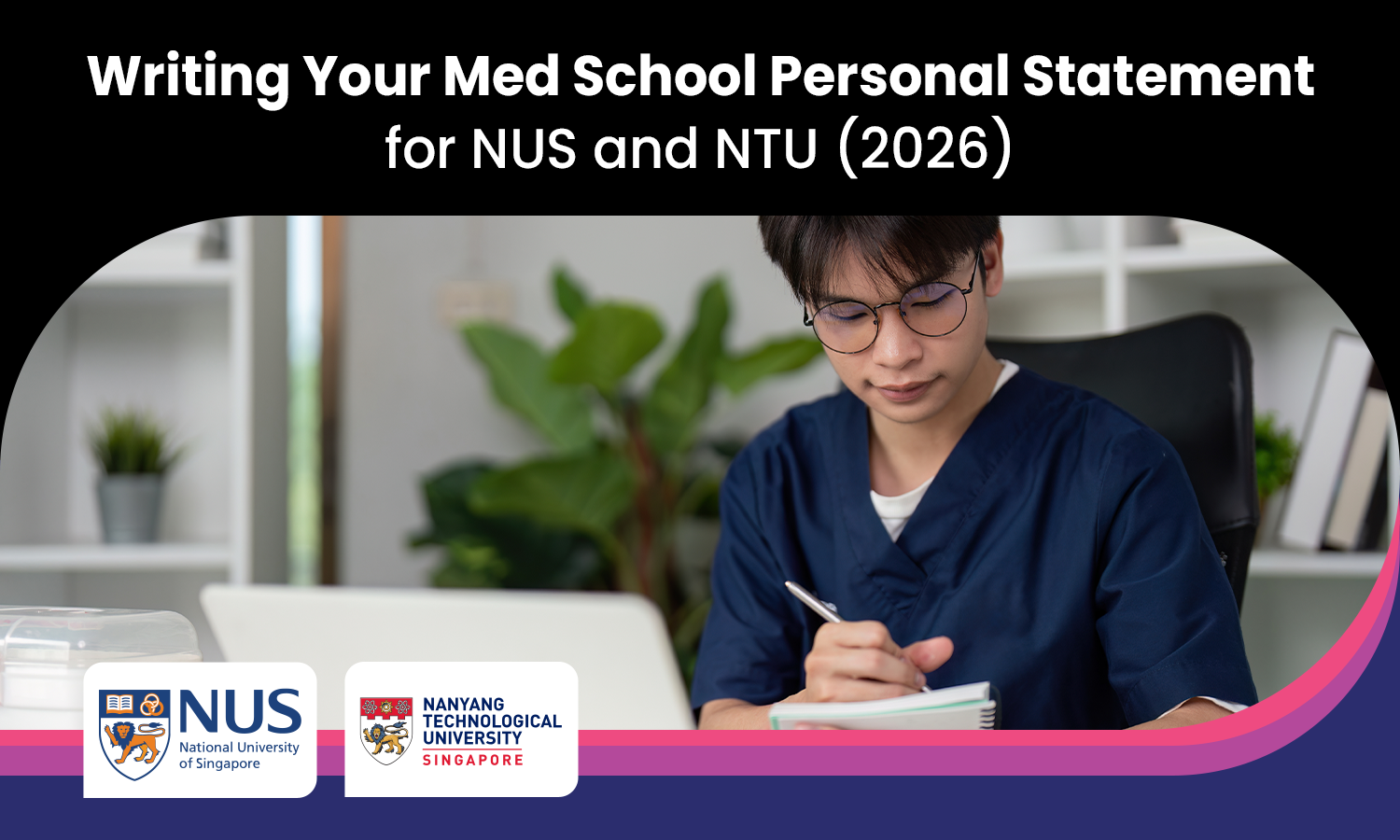
The personal statement is the single most important non-academic piece of writing in your Singapore medical school application. It is your opportunity to humanize your stellar grades and convince the admissions committee of your empathy, maturity, and commitment.
This guide provides a precise, step-by-step strategy for crafting compelling essays for both NUS (500 words) and NTU (300 words), incorporating the latest admission insights and answering the critical question: How to write a strong personal statement for med school?
How to Write a Strong Personal Statement for Medical Schools: A Step-by-Step Guide
Your personal statement must answer two fundamental questions for the admissions committee: "Why Medicine?" and "Why you?"
Step 1: Identify Your Core Qualities and Narrative
Before writing, identify 3-4 key qualities you want to showcase. These should align with the desired attributes of a doctor:
| Key Qualities | What Admissions Officers Look For |
| Empathy & Compassion | Your ability to understand and share the feelings of others, proven through service or clinical interactions. |
| Resilience & Endurance | Your ability to manage stress and recover from setbacks (Med school is a marathon). |
| Leadership & Teamwork | Your ability to function effectively within a hierarchy (essential in healthcare teams). Crucial for NTU. |
| Critical Reflection | Your capacity to learn from experiences and gain a realistic view of the medical profession. |
Step 2: Show, Don't Tell and the Winning Structure
We recommend a four-to-five paragraph structure that focuses heavily on reflection rather than simply listing activities.
| Paragraph | Focus & Content | Goal |
| Introduction | The Hook (Motivation): Start with an anecdote or pivotal moment that sparked your interest. Do not use clichés (e.g., "I want to help people"). | Immediately grab the reader's attention and state your commitment. |
| Body 1: Clinical Experience | Detail a single, high-impact clinical experience (e.g., shadowing, long-term volunteering). Focus on what you observed and how it influenced your view of the job. | Demonstrate an informed decision to pursue medicine, showcasing empathy and resilience. |
| Body 2: Non-Clinical Skills | Use an extracurricular activity (e.g., sports, CCA, research) to demonstrate transferable skills like leadership, teamwork, or discipline. | Prove you have the soft skills to succeed in a team and handle the rigor of the curriculum. |
| Conclusion | Future Vision: Reiterate your passion and state how the specific school (NUS/NTU) will help you become the doctor you aspire to be. | End with a clear, concise statement of purpose and your "fit" with the university. |
Step 3: Mastering the Word Count (NUS 500 vs. NTU 300)
The difference between the two essays is significant and requires strategic condensation.
| Element | NUS Strategy (500 Words) | NTU Strategy (300 Words) |
| Experiences | Can include 2-3 substantial experiences (1 clinical, 1 non-clinical/research). | Maximum 2 experiences. Be ruthlessly selective and concise. |
| Focus | Aim for depth and emotional reflection. Use narrative elements to connect concepts. | Focus only on actions and outcomes. Explicitly use keywords like "leadership" and "teamwork." |
| Flow | Start with your motivation in a dedicated paragraph. | Integrate your motivation into the first sentence of your first experience paragraph to save space. |
| Tone | Comprehensive, thoughtful, and reflective. | Direct, impactful, and action-oriented. |
Step 4: The Final Polish (Avoiding Common Pitfalls)
| Pitfall | Why it Fails | Solution |
| The "Listing" Error | Simply listing achievements (e.g., "I volunteered at X, did Y, and achieved Z") provides no insight. | Every sentence must include reflection. Example: "Observing the nurses handle patient fatigue showed me the true meaning of compassionate endurance." |
| The "Single Moment" Trap | Basing your entire motivation on one traumatic or inspiring event (e.g., a childhood illness). | Show an accumulation of experiences that progressively cemented your decision. Medicine is a sustained commitment, not a singular impulse. |
| The Generic Ending | "I want to help people/make a difference." | Link your desire to the specific needs of Singapore's healthcare system or the unique features of the NUS/NTU curriculum. |
Conclusion & Next Steps
Your Personal Statement is your voice in a stack of perfect academic records. A strong essay does not just repeat your CV; it provides the psychological and ethical framework for your ambition. It is the component that earns you the interview slot. Given the minimal word count, every word counts, making expert review essential.
If you need personalized guidance to distill your unique journey into a powerful 300-word or 500-word statement, contact an Icon Education admissions consultant today. We specialize in helping you find your narrative, maximize reflection, and ensure your essay hits every required mark for NUS and NTU Medicine