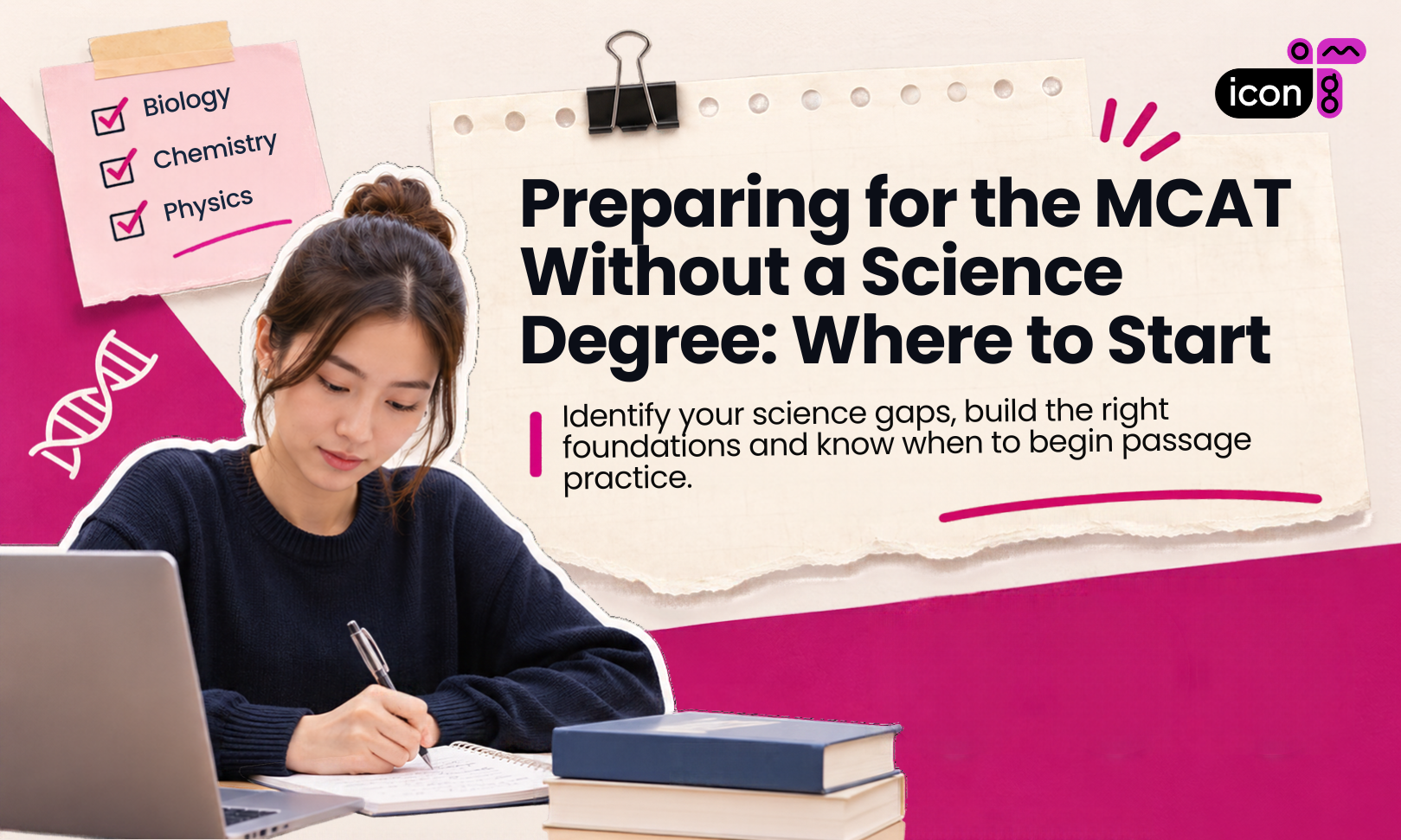

Preparing for the MCAT without a science background can make it difficult to know what to do first.
If biology, chemistry or physics is unfamiliar, starting with full MCAT passages may leave you guessing at concepts you have never learned. But trying to relearn every university science course before attempting a passage can also waste time.
A better starting question is:
Which foundations do I need, where are my actual gaps, and when am I ready to apply them?
You do not need a science degree simply to take the MCAT, provided you otherwise meet the AAMC’s eligibility rules. However, the exam still draws on substantial introductory-level science content, including biology, general and organic chemistry, physics, biochemistry, psychology and sociology.
For students considering the MCAT as non-science graduates, the goal is therefore not to “learn all of science”. It is to build enough of the right foundations to understand and apply the concepts the exam actually tests.
This guide focuses on that foundations-first process rather than another fixed study calendar.
Which Foundations Does the Exam Require?
The MCAT has four sections:
- Biological and Biochemical Foundations of Living Systems
- Chemical and Physical Foundations of Biological Systems
- Psychological, Social, and Biological Foundations of Behavior
- Critical Analysis and Reasoning Skills, or CARS
The three knowledge-based sections combine foundational content with scientific inquiry and reasoning. The AAMC also expects candidates to work with experimental information, tables, graphs and unfamiliar applications rather than rely only on memorized facts.
For students without recent science study, those sections may require the most foundation rebuilding.
A Practical MCAT Foundation Map
| Area | Foundation to check | What readiness looks like |
|---|---|---|
| Biology | Cells, genetics, physiology and biological systems | You can explain a mechanism and predict what may change when part of a system is altered |
| Biochemistry | Proteins, enzymes, biomolecules and metabolism | You can connect molecular processes to experimental results |
| General chemistry | Bonding, equilibrium, acids and bases, thermodynamics and related concepts | You can apply a concept rather than only recall its definition |
| Organic chemistry | Functional groups, molecular structure and relevant reactions | You can recognize useful chemical relationships in biological contexts |
| Physics | Forces, energy, fluids, electricity, waves and quantitative relationships | You can select a relevant relationship and work with units or graphs |
| Psychology | Behavior, cognition, learning and related concepts | You can distinguish similar concepts and apply them to scenarios |
| Sociology | Social structures, groups, inequality and health-related social factors | You can apply concepts to populations and health contexts |
| Research and data | Variables, experimental design, statistics, tables and graphs | You can identify what was tested and what the results actually support |
This table is a planning summary. Use the full AAMC Content Outline as the reference for what may be tested.
Do You Need Organic Chemistry for the MCAT?
Organic chemistry is included in the tested content.
That does not mean you should try to master every topic from an entire university organic chemistry course before beginning MCAT practice.
Instead, use the AAMC Content Outline to identify the concepts that are relevant to the exam and then test whether you can apply them in MCAT-style contexts.
The same principle applies across MCAT foundation preparation:
Use the official outline as your syllabus, not the size of a textbook.
CARS is different. It tests comprehension, analysis and reasoning from passages rather than requiring the same science-content foundation.
How Can You Diagnose Gaps?
Do not begin by asking:
“Am I bad at chemistry?”
That is too broad to produce a useful study decision.
The AAMC recommends starting with the official Content Outline, establishing a baseline with its Unscored Sample Test, and then reviewing the Content & Skills Breakdown to identify gaps. Its study-planning guidance also suggests classifying areas according to how confident you are with the material.
A simple process is:
AAMC Content Outline → baseline test → Content & Skills Breakdown → identify low-, medium- and high-confidence areas
Then add a second layer:
What kind of gap caused the problem?
An Icon-Style Diagnostic Review
For each weaker topic, ask:
| Question | What it helps identify |
|---|---|
| Can I explain the core concept without immediately checking notes? | Foundation gap |
| Can I connect it to another relevant concept? | Foundation/application gap |
| Can I interpret a graph or table involving it? | Application/reasoning gap |
| Can I apply it when the question does not tell me which concept to use? | Application gap |
| Can I explain why my answer was wrong? | Review quality |
Then classify the mistake:
Foundation gap — you do not yet understand the core concept.
Application gap — you know the content but struggle to use it in a new context.
Reasoning gap — you understand the concept but misread the evidence, variables or conclusion.
Timing gap — you can solve the problem accurately but too slowly.
This diagnostic is an instructional framework, not an official AAMC scoring tool.
Two Fictional Starting Profiles
The profiles below are fictional examples designed to show why two students without traditional pre-medical backgrounds may need very different plans.
Profile 1 — Business Graduate
Existing strengths
- reading dense material;
- basic quantitative reasoning;
- study and organizational skills.
Main gaps
- biochemistry;
- organic chemistry;
- physiology;
- recent physics knowledge.
Useful starting priority
Build core biology and chemistry foundations before relying heavily on timed science passages.
CARS can still begin earlier because it does not require the same science-content rebuild.
Profile 2 — Engineering Graduate
Existing strengths
- physics;
- equations and units;
- graphs;
- quantitative reasoning.
Main gaps
- biology;
- biochemistry;
- psychology;
- sociology.
Useful starting priority
Target the weaker biological and behavioral-science foundations rather than repeating quantitative content that is already strong.
The key lesson is:
Your actual gaps matter more than the name of your undergraduate degree.
What Should You Learn Before Passage Practice?
You do not need to complete every point in the AAMC outline before attempting your first passage.
But passage practice becomes much more useful when you have enough background knowledge to understand what the problem is asking.
A practical learning sequence for someone rebuilding a large science foundation might be:
- Core biology and general chemistry
- Biochemistry and relevant organic chemistry
- Physics foundations
- Psychology and sociology
- Research methods, graphs and data interpretation
This is a planning example, not an official AAMC-required course order. Your diagnostic may justify a different sequence.
Use a Foundation-to-Passage Bridge
Instead of separating “content review” and “practice” completely, use a short cycle:
learn → recall → apply → try a passage → classify the error
For example, after reviewing enzyme kinetics:
- explain the main relationships from memory;
- interpret a simple enzyme graph;
- predict how a change in conditions may affect the result;
- try relevant MCAT-style questions;
- review whether any mistake came from knowledge, application or reasoning.
This helps answer an important question:
Is the foundation becoming usable?
You can increase mixed passage practice when your mistakes begin to shift from:
“I did not know this concept.”
toward:
“I knew the concept, but I applied it incorrectly.”
At that point, the issue is increasingly about MCAT reasoning rather than basic content acquisition.
For the wider progression from baseline testing to mixed practice and full-length exams, see Icon Education’s How to Prepare for the MCAT in Three Months.
How Do Exam Preparation and University Prerequisites Differ?
This distinction is especially important for students searching for MCAT science prerequisites.
There are three separate questions:
| Question | What it means |
|---|---|
| Can I register for the MCAT? | Whether you meet the AAMC’s eligibility rules |
| Am I ready for the MCAT? | Whether you have enough knowledge and reasoning skill to use the tested content effectively |
| Am I eligible for my target medical school? | Whether you meet that university’s degree, coursework, test and other admissions requirements |
These questions are related, but they are not interchangeable.
The AAMC does not require a specific set of college science courses simply to register for the MCAT if you otherwise meet its eligibility rules. It does, however, advise candidates to consider additional coursework or study if they are not yet comfortable with the tested content.
A medical school may have a completely different set of admissions requirements.
Duke-NUS as an Example
As of November 2026, Duke-NUS requires applicants to have completed, or be in the final year of, a bachelor’s or honours degree and to submit an MCAT or GAMSAT result. Its current admissions information does not restrict applicants to a particular undergraduate discipline.
This creates an important distinction.
A business, engineering or humanities graduate may be eligible to apply to Duke-NUS while still needing substantial science preparation before sitting the MCAT.
In other words:
Medical-school eligibility does not automatically mean MCAT readiness.
If Duke-NUS is one of your target schools, see Icon Education’s How to Get into Duke-NUS Medical School 2027 for the broader admissions process.
For every target medical school, verify:
- accepted undergraduate qualifications;
- required prerequisite coursework, if any;
- accepted admissions tests;
- score-validity rules;
- application-cycle requirements.
Do this directly from the university’s current admissions pages.
The AAMC Content Outline tells you what you need to prepare for the exam.
Your target medical school tells you what you need to meet for admission.
Final Takeaway
Preparing for the MCAT without a science background should begin with your actual gaps, not an arbitrary calendar.
Start with:
AAMC Content Outline → establish a baseline → identify weak areas → build foundations → apply concepts → increase passage practice → review error patterns
Keep two questions separate throughout:
Am I ready for the MCAT?
and:
Am I eligible for my target medical school?
They require different evidence.
A strong preparation plan addresses both without confusing them.
Assess your starting point and build a realistic MCAT preparation plan.