
Excerpt
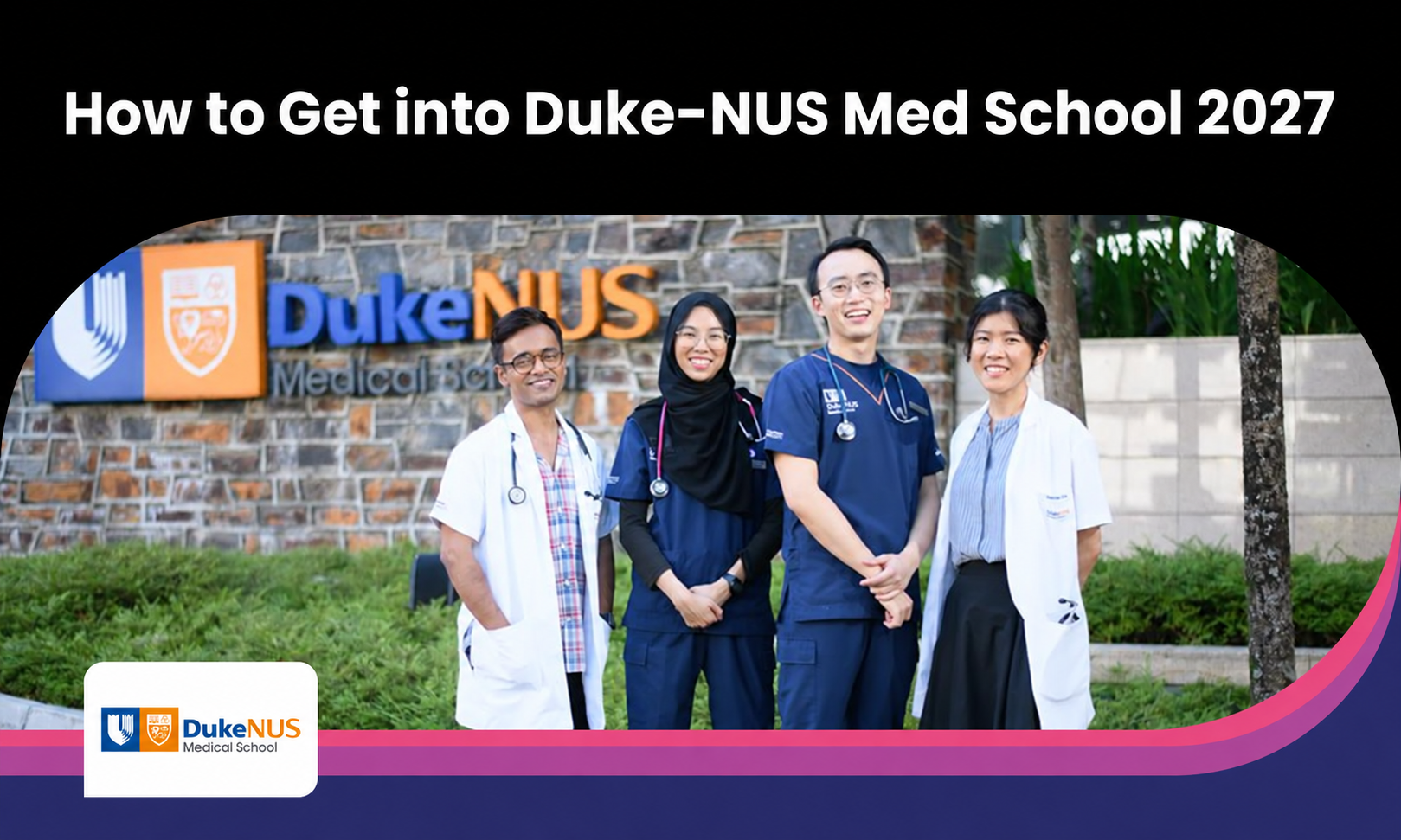
Duke-NUS Medical School stands apart as Singapore's only graduate-entry medical school, requiring applicants to hold a Bachelor's degree. Its Doctor of Medicine (MD) programme is globally renowned and highly selective, with an acceptance rate estimated to be around 3.2%.
Gaining admission to Duke-NUS requires a unique blend of exceptional academic performance in undergraduate studies, a top-tier score on a standardised admissions test (MCAT or GAMSAT), and a proven record of research and healthcare commitment. This guide provides the mandatory requirements and strategies for Singaporean applicants aiming for the 2026 intake.
What Duke-NUS Looks For in 2027?
Duke-NUS adopts a holistic, U.S.-style admissions process, prioritizing candidates who demonstrate the potential to embody their 'Clinicians Plus' vision. The four core pillars of the admissions process are:
-
Academic Excellence: Performance in your Bachelor's degree (GPA).
-
Standardised Aptitude: A top score on the MCAT or GAMSAT.
-
Extracurricular Profile: Proven commitment to leadership, research, and healthcare.
-
Fit and Motivation: Demonstrated passion and suitability during Applicant Day (Interviews/Written Tasks).
1. Academic Prerequisites
All applicants must have completed, or be in the final year of, a Bachelor's degree or Honours degree from any discipline. Unlike undergraduate programmes, there are no specific subject prerequisites, but a science background is advantageous for the MCAT/GAMSAT.
Source: Duke-NUS Student Information
| Metric |
Average for Admitted Class |
Competitive Target |
| Undergraduate GPA (out of 4.0) | 3.71 | 3.7 and above |
| MCAT Score (out of 528) | 514 | 515 and above (approx. 90th percentile) |
| GAMSAT Score | Not officially stated, but highly competitive. | 68 and above (approx. 90th percentile) |
2. Standardised Testing Requirement: MCAT or GAMSAT
The submission of either the Medical College Admission Test (MCAT) or the Graduate Medical School Admissions Test (GAMSAT) score is a mandatory and critical component of the application.
| Test | Key Differences | Strategy |
| MCAT | Focuses heavily on foundational sciences (Physics, Chemistry, Biology, Biochemistry) and reasoning. Total score is 472-528. | Best for applicants with a strong background in physical and biological sciences (e.g., NUS/NTU Science/Engineering graduates). |
| GAMSAT | Focuses more on scientific reasoning, essay writing (Section II), and humanities/social sciences (Section I). | Often preferred by applicants from non-science backgrounds (e.g., Humanities, Business, Law), but still requires science preparation. |
The Application & Portfolio (Required Submissions)
The Duke-NUS application is a comprehensive package, requiring a significant amount of detailed documentation: admissions panel in identifying candidates actively committed to healthcare
| Component | Requirement | Notes |
| Essays | Personal Statement and Supplementary Essays | Questions focus on motivation, research interest, and personal background. Released with the application in June. |
| Reference Letters | 3 to 5 references | At least one must be an academic reference (e.g., Professor/Supervisor). Others can be from employers or mentors. |
| Transcripts | Official transcripts from all previously attended institutions. | Non-Singapore/US degree holders must submit transcripts to World Education Services (WES) for evaluation. |
| Research/Activities | Detailed listing of all extracurricular activities, volunteering, and research experience. | Research experience is highly valued and often a key differentiator. |
The Admissions Assessment: Applicant Day
Shortlisted candidates are invited to an Applicant Day, which typically involves a full day of evaluations and activities. This process is highly focused on assessing non-cognitive traits and your alignment with the school's mission.
| Assessment Component | Purpose |
| Interviews | Typically includes multiple interviews with faculty and alumni to assess communication, motivation, and ethical reasoning. |
| Discussion Sessions | Small group interactions designed to evaluate teamwork, critical thinking, and collaborative skills. |
| Written Exercise | A written task to gauge your ability to analyze, synthesise, and present information clearly under pressure. |
| Faculty/Student Interaction | Opportunities to interact with the Duke-NUS community to determine mutual fit. |
Tips to Enhance Your 2027 Application
-
Prioritise Research Experience and a High-Impact GPA: Duke-NUS considers research experience holistically alongside academic achievement, references, volunteering, and leadership. While the application requests details of your research activities and having experience is highly recommended, there is no prescribed minimum duration, nor is a publication or poster presentation required.
-
Aim for the 90th Percentile on the Standardised Test: With average MCAT scores around 513, you must target the 90th percentile (515+) to be competitive. Choose between the MCAT and GAMSAT based on your academic strengths, but dedicate a structured 4-6 months to preparation to hit this benchmark.
-
Curate the 'Clinicians Plus' Narrative: Your essays, recommendation letters, and interview performance must clearly articulate how you align with Duke-NUS’s 'Clinicians Plus' vision. Rather than focusing solely on clinical care, show how you intend to be a multi-faceted medical professional—whether that is as a scientist, educator, innovator, or leader driving improvements in healthcare.
Conclusion & Next Steps
Admission to Duke-NUS is a rigorous process that assesses intellectual capacity, aptitude, and maturity. As a graduate-level MD programme, it requires a depth of experience—both academic and professional—that far exceeds undergraduate entry. Successfully navigating the MCAT/GAMSAT, multiple essays, and the Applicant Day requires specialised guidance.
If you are a graduate student or current undergraduate aiming for the competitive 2026 intake, strategic preparation starting well over a year in advance is essential.
Get in touch with one of our consultants today for specialised preparation in MCAT/GAMSAT, essay refinement, and interview training to maximise your chances of joining the next Duke-NUS MD class.

Additional resources
https://www.icon-plus.com/articles/sg-med-guide
https://youtube.com/difference-between-nus-and-ntu-medicine
https://www.icon-plus.com/articles/day-in-the-life-of-a-doctor-uk-vs-singapore