
Getting shortlisted for NUS Medicine means you have already met the academic threshold. The next stage tests something different: how you communicate, collaborate, respond to unfamiliar situations and demonstrate the qualities NUS Medicine looks for in future medical students.
For the 2027 admissions cycle, shortlisted applicants will attend the Focused Skills Assessment (FSA) in person. NUS states that the FSA assesses a candidate’s aptitude for Medicine and whether their values align with NUS Medicine. Academic and medical knowledge are not tested.
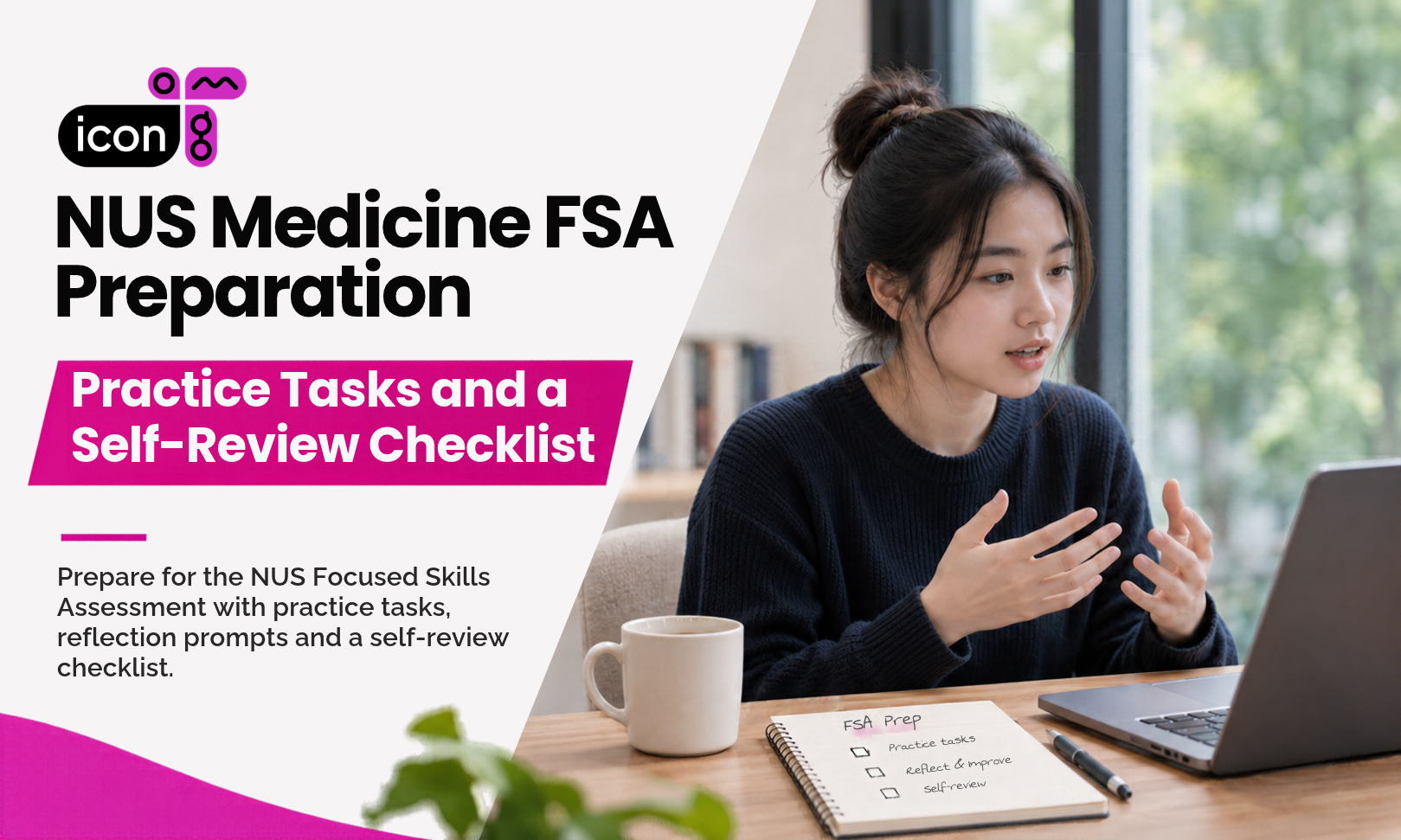
This guide focuses specifically on NUS FSA preparation. Rather than attempting to predict live questions, it shows you how to practice the skills required by the published format, work through three original practice exercises and review your performance systematically.
For the complete application journey, see Icon Education’s How to get into NUS Medicine in 2027.
What Does NUS Officially Say About the FSA?
NUS currently describes the FSA as an in-person assessment lasting approximately 90–120 minutes, consisting of 5–7 stations.
The stations may include a mixture of four formats:
| Official FSA station type | What NUS says happens |
|---|---|
| Role-Play Station | You interact with a trained actor while an interviewer assesses how you engage with them |
| Task-Based Station | You are given several tasks to complete within a specified timeframe, with the aim of completing as many as possible |
| Group Station | A group of 3–5 candidates completes a task or activity within given rules and time constraints |
| Interview Station | An interviewer explores your motivation and aptitude for Medicine or presents a scenario for discussion |
NUS states that no preparation is required for the FSA because academic knowledge is not tested, and candidates are encouraged to stay calm and be themselves.
That does not mean applicants need to memorize nothing and simply hope for the best. From a preparation perspective, you can familiarize yourself with the published station formats and practice behaviors such as clear communication, careful listening, teamwork and reflection — without attempting to memorize predicted answers.
The Situational Judgement Test (SJT), which previously formed another part of the admissions assessment, has been discontinued from 2026.
2027 FSA Dates
NUS currently lists the following FSA dates for 2027:
2, 3, 5, 6, 10, 12 and 13 April 2027.
Shortlisting takes place during the last week of March, so the period between receiving an invitation and attending the FSA may be relatively short. Candidates must attend the FSA in person to remain under consideration for Medicine.
Which Skills Can You Practice for the NUS FSA?
NUS does not publish an applicant-facing scoring rubric, so preparation should not invent one.
However, NUS does identify qualities considered during selection, including pro-social behavior, strong communication skills, insight, integrity, teamwork, meticulous work habits and a sense of responsibility.
You can practice these qualities through the published station formats.
Listen Before Solving
In a role-play, avoid immediately telling the other person what they should do.
First establish what has happened, what information is missing and what the person may be concerned about. A response that begins with careful listening is usually more adaptable than one built around a rehearsed solution.
Communicate Your Reasoning Clearly
Your answer does not need to sound complicated.
A useful structure is:
Issue → missing information → options → reasoning → next step
If the situation changes, explain why your response changes with it.
Follow Instructions Carefully
Task-Based Stations make attention to detail particularly relevant.
Before starting:
- identify the objective;
- notice the constraints;
- decide what to prioritize;
- monitor your time;
- check completed work where possible.
Completing more tasks is not useful if you repeatedly ignore instructions.
Contribute Without Dominating
In a group activity, speaking the most does not necessarily mean contributing the most.
Practice helping the group move forward: clarify the objective, build on other people’s suggestions, invite quieter members into the discussion and change your position when someone presents stronger reasoning.
Reflect on Your Own Experiences
For interview-style discussion, review experiences already included in your portfolio.
Ask yourself what you contributed, what was difficult, what you learned from other people and what you would do differently now.
For broader medical interview guidance, see Icon Education’s How to Answer Medical School Interview Questions MMI. The NUS FSA and other schools’ MMI formats should not, however, be treated as identical assessments.
Three Original Practice Exercises
Important: The exercises below are Icon-created practice tasks. They are not recalled NUS questions, leaked questions or predictions of what will appear in the 2027 FSA.
Practice 1: Role-Play — The Overwhelmed Teammate
You are working on a school community project. One teammate has missed two meetings and has not completed their assigned work.
When you speak to them privately, they say:
“I know everyone is annoyed with me. I’ve just had too much going on lately.”
Your task: Continue the conversation and decide how you would move forward.
Afterward, review whether you:
- listened before proposing a solution;
- avoided making assumptions;
- balanced empathy with responsibility;
- clarified what still needed to be completed;
- ended with a realistic next step.
Practice 2: Task-Based — Accuracy Under Time Pressure
This exercise is designed to imitate the multi-task nature of the published Task-Based format, not the content of an actual NUS station.
Set a timer for seven minutes and complete as many of these four tasks as accurately as possible:
- Arrange ten numbered cards according to three written ordering rules.
- Review a short weekly timetable and identify five scheduling conflicts.
- Copy a simple geometric pattern accurately onto another sheet.
- Read six short instructions and place them in the correct sequence.
Before beginning, read all four tasks once.
After the timer ends, ask:
- Did I understand the instructions before starting?
- Which tasks did I prioritize, and why?
- Did I sacrifice accuracy for speed?
- Did I notice errors before moving on?
- Did I spend too much time on one task?
The objective is not to become good at these particular activities. It is to observe how you prioritize, switch between tasks and maintain accuracy under time pressure.
Practice 3: Group Exercise — Agree on One Plan
Complete this exercise with 3–5 people if possible.
Your group has been asked to design a 45-minute orientation session for 30 new students.
Choose only three of the following:
- campus tour;
- peer introductions;
- study-planning workshop;
- CCA showcase;
- well-being activity;
- student Q&A.
Your group has eight minutes to choose three activities, decide their order and explain the final plan.
Afterward, reflect on:
- who kept the group focused on the objective;
- whether everyone had space to contribute;
- how disagreement was handled;
- whether anyone changed their view after hearing stronger reasoning;
- whether the group reached a clear decision within the time.
How Should You Respond to an Unfamiliar Situation?
Trying to memorize an answer for every possible scenario is unlikely to help when the actual situation is different from what you practiced.
Instead, use a simple reasoning process.
1. Identify the Actual Task
Ask:
What exactly am I being asked to do?
Do not answer a familiar question simply because the scenario reminds you of one.
2. Separate Facts from Assumptions
Identify:
- what you know;
- what you are assuming;
- what additional information would affect your response.
This prevents you from building an answer around details the scenario never provided.
3. Consider the People Involved
Think about who is affected and what each person may reasonably be concerned about.
Recognizing another perspective does not mean you must agree with it.
4. Choose a Proportionate Next Step
Avoid immediately jumping to the most extreme response.
Explain what you would do first and what circumstances would make you escalate, seek guidance or reconsider your decision.
5. Adapt When New Information Appears
If an interviewer introduces new information, use it.
Changing your answer after receiving relevant information can demonstrate stronger reasoning than defending your original position simply for the sake of consistency.
How Can You Review a Mock FSA Response?
Practice becomes more useful when each attempt produces one specific lesson for the next.
The following is an Icon-created self-review framework, not an official NUS scoring rubric.
| Review area | Questions to ask |
|---|---|
| Task understanding | Did I respond to the task that was actually given? |
| Communication | Was I clear, and did I listen as well as speak? |
| Reasoning | Did I separate facts from assumptions and explain my decisions? |
| Awareness of others | Did I consider relevant perspectives? |
| Teamwork | Did my behavior help the group make progress? |
| Integrity & responsibility | Did I respond honestly and acknowledge my responsibilities? |
| Meticulousness | Did I follow instructions and check important details? |
| Adaptability | Did I adjust constructively when circumstances changed? |
| Time awareness | Did I use the available time effectively? |
Avoid writing feedback such as:
“I need to communicate better.”
Make it observable instead:
“In my next role-play, I will ask one clarifying question before suggesting a solution.”
Keep a Short Practice Log
| Date | Station type | Skill practiced | What worked | What needs improvement | Next change |
|---|---|---|---|---|---|
| Example | Role-play | Listening | Allowed the person to explain first | Suggested solutions too quickly | Ask one clarifying question before proposing action |
After several attempts, look for repeated patterns. If the same issue appears in multiple sessions, that is probably a better preparation priority than simply completing more random questions.
Final Takeaway
NUS does not test academic or medical knowledge during the FSA, nor does effective preparation require memorizing a bank of predicted questions.
The published format places candidates in different situations: interacting with another person, completing tasks, working in a group and discussing their motivation or an unfamiliar scenario with an interviewer.
Your preparation should therefore focus on how you behave within those situations: understand the task, listen carefully, communicate your reasoning, follow instructions, collaborate constructively and reflect after each attempt.
Most importantly, use practice exercises to develop transferable skills — not to guess what NUS will ask.
For applicants who want to practice realistic interview situations and receive individual feedback on their communication, reasoning and responses under pressure, Icon Education provides personalized interview coaching.