Excerpt
Gaining admission to the National University of Singapore (NUS) Yong Loo Lin School of Medicine's Bachelor of Medicine and Bachelor of Surgery (MBBS) programme is one of the most competitive challenges for a student in Singapore. With approximately 2,800 applicants vying for only about 280 places annually, every part of your application matters.
The 2026 admissions cycle brings a significant change to the assessment process, focusing more intensely on the Focused Skills Assessment (FSA). This guide demystifies the updated journey, prerequisites, and key strategies for Singaporean students and their parents to secure a coveted spot in the 2026 intake.
What does NUS Medicine look for in 2026?
NUS Medicine seeks highly motivated individuals with a strong academic foundation, a deep commitment to serving the healthcare sector, and the aptitudes required for medical practice.
1. Academic Prerequisites (Standard Scheme)
First-time applicants are primarily shortlisted based on stellar academic grades. The typical successful profile for admission via the Standard scheme remains exceptionally high:
|
Qualification |
Indicative Grade Profile (10th-90th Percentile) |
Key Subject Prerequisites |
|
Singapore-Cambridge 'A' Levels |
AAA/A for both the 10th and 90th percentile (RP at least 87.5) |
A good H2 Pass in Chemistry and H2 Pass in Biology or Physics. |
|
Polytechnic Diploma |
GPA: 3.74 to 3.93 |
An accredited diploma, ideally in a health science-related discipline. |
|
International Baccalaureate |
~ 42 to 45 points |
A good Higher Level (HL) Pass in Chemistry and HL Pass in Biology or Physics. |
|
NUS High School |
Major CAP at least 2.0 in Chemistry and Biology/Physics |
Major CAP at least 2.0 in Chemistry and Biology/Physics. |
2. Standardised Testing (UCAT Clarification)
For applicants with Singaporean GCE 'A' Levels, Polytechnic Diplomas, or NUS High School Diplomas, a supplementary qualification like the UCAT is NOT required.
However, for students submitting International Qualifications or Predicted International Baccalaureate (IB) results, a supplementary test is REQUIRED for shortlisting. The common choice is:
- UCAT (UK or ANZ)
- Alternatively: SAT/ACT with Writing and SAT Subject Tests/AP Exams
3. Aptitude-Based Admissions Scheme (ABAS)
The ABAS is the pathway for repeat applicants or those who do not meet the indicative cut-off point but have demonstrable and exceptional co-curricular achievements, leadership, or talents that evidence their suitability for the MBBS programme. All applicants must apply through the main NUS portal, but selecting ABAS flags your application for a comprehensive review of your Portfolio alongside your academic results during the initial shortlisting stage.
The Medicine Portfolio
The Portfolio is a mandatory submission for all applicants and is used to holistically assess your suitability and motivation. The information aids the admissions panel in identifying candidates actively committed to healthcare.
Your portfolio submission consists of:
- Personal Statement (500 words): A concise essay articulating your journey, motivation, and why you are the right fit for NUS Medicine.
- Top 10 Achievements and Activities: A list of your most significant experiences over the past 4 years (e.g., volunteering, medical attachments, research, CCA leadership).
- Official School Testimonial: A recommendation from your school.
- Two Letters of Reference: Professional or academic recommendations.
The Portfolio is a mandatory submission for all applicants and is used to holistically assess your suitability and motivation. The information aids the admissions panel in identifying candidates actively committed to healthcare.
UPDATED Admissions Assessment for 2026
This is the most critical update for the 2026 cycle.
The Admissions Assessment is now streamlined and comprises a single component for shortlisted candidates:
|
Component |
Status for 2026 Admission |
Date (Tentative) |
|
Focused Skills Assessment (FSA) |
REQUIRED (In-person) |
Late March / Early April 2026 |
|
Situational Judgement Test (SJT) |
DISCONTINUED from 2026 |
N/A |
Focused Skills Assessment (FSA)
The FSA is an in-person, Multiple Mini-Interview (MMI) style assessment designed to evaluate your non-academic attributes essential for a medical career. This is where your portfolio experience and personal qualities are tested.
What is assessed:
- Ethical Reasoning
- Critical Thinking and Problem Solving
- Communication Skills
- Empathy and Compassion
- Teamwork and Collaboration
Strategy for Success: With the removal of the SJT, performance in the FSA becomes the primary, and arguably sole, determinant for selection after academic shortlisting. Preparation should focus heavily on situational and ethical scenarios, practicing clear and structured communication.
Key Dates and Timeline (2026 Cycle)
|
Event |
Tentative 2026 Timeline |
Notes |
|
Application Portal Opens |
Mid-December 2025 |
NUS Application Portal (Step 1) opens. |
|
Application Deadlines |
Poly Diplomas: Early February 2026 A-Levels: Mid-March 2026 IB/International: Late February 2026 |
Submit main NUS application and indicate Medicine as first or second choice. |
|
Medicine Portfolio Submission |
Early March 2026 (TBC) |
Submit portfolio via the dedicated NUS Medicine portal (Step 2). |
|
Shortlisting Notification |
Last Week of March 2026 |
Candidates invited to the Admissions Assessment. |
|
Focused Skills Assessment (FSA) |
Late March to Mid-April 2026 |
In-person assessment. SJT is discontinued. |
|
Admission Outcome |
Early to Mid-May 2026 |
Offer status updated on the NUS Applicant Portal. |
Tips to Enhance Your 2026 Application
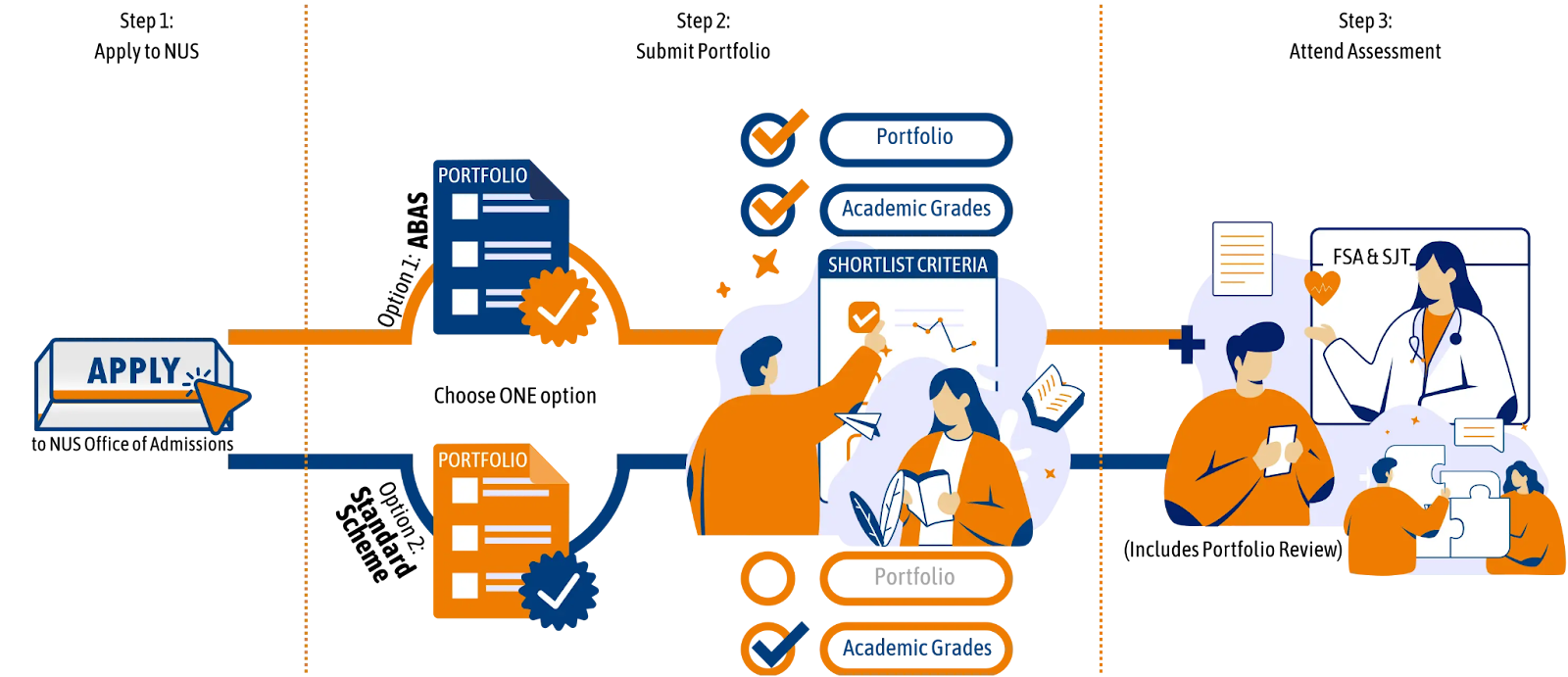
Image reference: https://medicine.nus.edu.sg/prospective-students/how-to-apply/
Standing out in a pool of high-achievers requires more than just excellent grades. Success lies in how you leverage your experience to demonstrate your suitability.
- Prioritize Quality Clinical/Healthcare Exposure (Experience):
- The Problem: Many applicants lack genuine insight into the medical field.
- The Solution: Build deep, well-planned experience beyond basic volunteering. Focus on quality over quantity. This can include clinical attachments, long-term volunteering at hospices/eldercare, or medical-related research. This proves you have made an informed decision to pursue medicine.
- Master the Art of Reflection, Not Just Achievement:
- The Problem: Students list many impressive achievements but fail to connect them to their motivation for medicine.
- The Solution: For every experience in your Top 10 list, detail not what you did, but what you learned about the medical profession, and crucially, how it reinforced your desire to become a doctor. This connection is most vital in the FSA interview stage.
- Demonstrate 'Fit' with NUS Medicine's Ethos:
- The Problem: Generic applications that could be sent to any medical school.
- The Solution: Research the specific research focus, curriculum structure (e.g., NUS's unique phases), or community initiatives of NUS Medicine. Articulate which aspects genuinely appeal to you and how they will help you develop into the doctor you aspire to be. This shows you have done your homework and are committed to their programme.
Conclusion & Next Steps
Getting into NUS Medicine is an intensely competitive process—it is a marathon, not a sprint. While outstanding academics secure your initial shortlisting, your ultimate success depends entirely on a compelling Medicine Portfolio and a stellar performance in the Focused Skills Assessment (FSA).
If you are serious about securing one of the 280 places for the 2026 intake, strategic preparation is non-negotiable. Whether you need help curating your experiences for the Portfolio, writing a differentiating Personal Statement, or undergoing rigorous interview coaching for the FSA, our expert consultants are ready to guide you.
Don't leave your medical school admission to chance. Contact an Icon Education consultant today to schedule a chat and start building your winning application.

Additional resources
https://www.icon-plus.com/articles/sg-med-guide
https://youtube.com/difference-between-nus-and-ntu-medicine
https://www.icon-plus.com/articles/day-in-the-life-of-a-doctor-uk-vs-singapore