
Improving CARS is not always about reading faster or completing more passages.
If you keep making similar mistakes, the more useful question is:
Why did the wrong answer seem convincing?
A strong MCAT CARS strategy involves understanding the structure of a passage, separating evidence from unsupported assumptions and reviewing the reasoning behind each mistake.
The AAMC describes CARS as testing comprehension and reasoning through passages from the humanities and social sciences. The section broadly assesses three areas: Foundations of Comprehension, Reasoning Within the Text and Reasoning Beyond the Text.
You do not need outside subject knowledge to answer CARS questions. The information you need should come from the passage and the question itself.
This guide focuses on one practical skill: how to analyze a passage carefully and turn mistakes into useful information for your next practice session.
If you are trying to understand how to improve MCAT CARS, the goal is not simply to complete more passages, but to identify the reasoning patterns behind your mistakes.
What Should You Identify on a First Reading?
Answering MCAT CARS questions effectively starts before you look at the answer choices: you need a workable mental map of the passage.
Your first reading should help you understand the argument, not memorize every sentence.
For practice, one useful framework is to identify four things.
1. The Author’s Main Position
Ask:
What does the author ultimately want me to understand or accept?
The topic and the main argument are not necessarily the same.
A passage may discuss public art, education or technology, while the author’s actual position may be much narrower.
Try summarizing the author’s position in one sentence.
2. The Structure of the Passage
Notice what each part is doing.
For example, a passage might:
- introduce a debate;
- present one position;
- challenge that position;
- provide an example;
- acknowledge a limitation;
- reach a qualified conclusion.
You do not need to label every paragraph formally.
The goal is to know how the argument develops.
3. The Author’s Attitude
Look at the author’s wording.
Are they:
- supportive;
- skeptical;
- critical;
- neutral;
- qualified;
- cautiously optimistic?
Tone can help you distinguish between an answer that sounds related to the topic and one that actually reflects the author’s position.
4. The Support for the Main Claim
Ask:
What evidence or reasoning does the author use to support the conclusion?
This becomes especially important when an answer choice sounds reasonable but goes further than the passage does.
A useful mental summary might be:
The author argues X because Y, while acknowledging Z.
That is often more useful than trying to remember every detail.
How Do You Distinguish Evidence From an Assumption?
A common CARS mistake is turning something that seems plausible into something the passage has actually established.
Use this distinction:
Evidence: information directly provided by the passage.
Inference: a conclusion that can reasonably be supported by the passage, even if it is not stated directly.
Unsupported assumption: a conclusion that requires information the passage does not provide.
The following shortened exercise shows how these differences affect answer choices.
Shortened Original Practice Passage
This shortened passage and the questions below were created specifically for this article to isolate several CARS reasoning skills. They are not AAMC questions and are not intended to reproduce the full length or exact format of an official CARS passage.
Cities increasingly use public art projects to revitalize shared spaces. Supporters often describe murals, sculptures and temporary installations as tools for strengthening community identity. Critics respond that such projects can become decorative substitutes for addressing more difficult problems such as housing insecurity, transportation or unequal access to public services.
Both positions can exaggerate what public art is capable of doing.
A mural cannot repair an underfunded transportation system. Yet it would be equally mistaken to conclude that an activity has little civic value simply because it cannot solve a structural problem by itself.
Public art can create occasions for shared attention. People may stop, discuss an installation or reconsider a familiar space. These interactions are modest, but their modesty does not make them meaningless.
The difficulty begins when visible activity around an artwork is treated as proof of deeper social change.
One neighborhood study reported more pedestrian activity and informal conversation after several installations appeared in public spaces. However, the same period also included new shops, improved lighting and transportation changes. The study therefore could not establish that the art itself caused the increase in interaction.
This does not make the project unsuccessful. It simply means that the evidence supports a narrower conclusion than some advocates might prefer.
Public art should therefore be evaluated neither as a cure for urban inequality nor as irrelevant decoration. Its value may lie in creating opportunities for attention and conversation, provided these outcomes are not confused with evidence that larger structural problems have been solved.
Question 1
Skill focus: Foundations of Comprehension
Which statement best expresses the author’s main argument?
A. Public art should primarily be evaluated by whether it produces measurable economic improvements.
B. Public art can contribute to civic interaction, but its effects should not be confused with broader structural change.
C. Critics of public art underestimate the emotional importance of artistic expression.
D. Cities should stop funding public art until stronger causal evidence becomes available.
Question 2
Skill focus: Reasoning Within the Text
Which statement is most directly supported by the passage?
A. Neighborhoods with public art consistently experience greater social trust.
B. The neighborhood study proved that public art increased conversations among residents.
C. Several changes occurred during the study period, making it difficult to attribute increased interaction to public art alone.
D. Public art programs are less expensive than transportation and housing interventions.
Question 3
Skill focus: Reasoning Beyond the Text
Suppose a new study found that neighborhoods receiving public art installations experienced increased informal conversation even when no other major neighborhood changes occurred.
How would this finding most likely affect the author’s argument?
A. It would strengthen the claim that public art can create opportunities for social interaction.
B. It would prove that public art can solve structural urban problems.
C. It would weaken the author’s view that public art can have civic value.
D. It would show that economic investment is unnecessary for neighborhood improvement.
Why Are Tempting Answers Wrong?
Reviewing CARS should involve more than confirming the correct letter.
You should also understand why the wrong choices are wrong.
A tempting answer often contains an idea connected to the passage, but it may:
- exaggerate what the author claims;
- focus on a detail instead of the overall argument;
- introduce information not provided;
- confuse correlation with causation;
- misrepresent the author’s tone.
Question 1 — Correct Answer: B
A — Incorrect
The author never argues that economic outcomes should be the main measure of public art.
This answer introduces a standard that the passage does not establish.
B — Correct
This captures both parts of the conclusion: public art may contribute to civic interaction, but that should not be mistaken for evidence of structural change.
C — Incorrect
The passage discusses critics, but emotional expression is not the central issue.
This answer focuses on a related idea rather than the author’s main position.
D — Incorrect
This is too extreme.
The author explicitly argues that uncertainty about causation does not mean public art has no value.
Question 2 — Correct Answer: C
A — Incorrect
The word consistently makes the statement broader than the evidence.
The passage gives one example and does not establish a general rule about social trust.
B — Incorrect
This reverses an important part of the passage.
The author specifically says the study could not establish that public art caused the increased interaction.
C — Correct
This accurately reflects the passage: several changes happened at the same time, making causation difficult to establish.
D — Incorrect
The passage contains no comparison of program costs.
The answer may sound plausible, but it requires outside information.
Question 3 — Correct Answer: A
A — Correct
The new evidence would strengthen the narrower claim that public art may encourage social interaction.
B — Incorrect
An increase in conversation does not prove that public art can solve larger structural problems.
The conclusion is much broader than the evidence.
C — Incorrect
The finding would support, rather than weaken, part of the author’s argument.
D — Incorrect
The new study provides no evidence about whether economic or infrastructure investment is necessary.
The key question is:
What exactly does the new information support?
Do not allow a conclusion to become broader than the evidence behind it.
What Should You Record After Practice?
Checking your percentage correct tells you how many questions you missed.
It does not tell you why you missed them.
That is where a CARS-specific error log becomes useful.
Icon Education’s How to Prepare for the MCAT in Three Months recommends reviewing errors systematically rather than simply completing more questions.
For CARS, take that process one step further by recording the reasoning pattern behind each mistake.
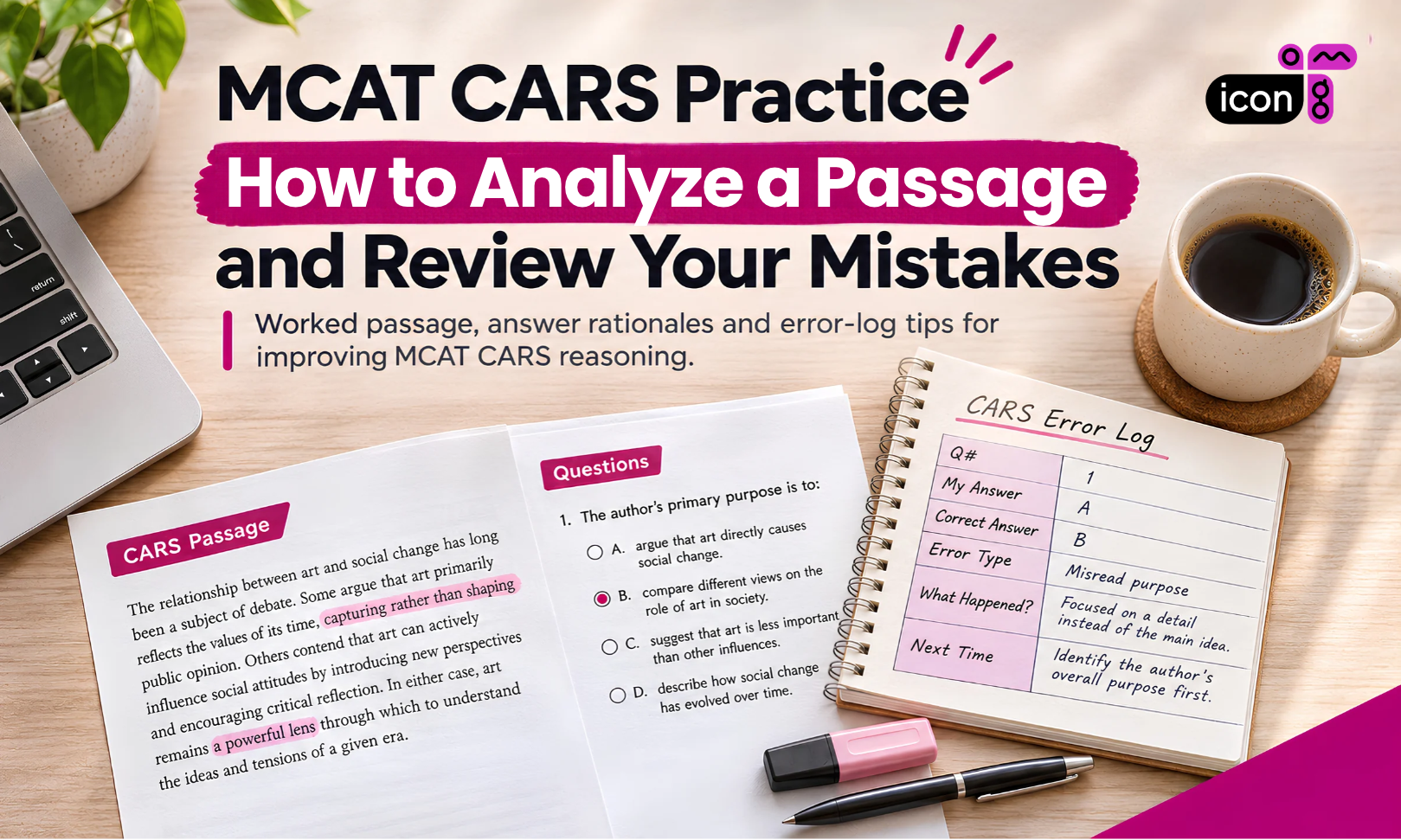
A Simple CARS Error Log
If your goal is to improve MCAT CARS over time, your review should identify a repeatable reasoning problem rather than simply record a wrong answer.
|
Field |
What to record |
|
Question type |
Main idea, evidence, inference, Reasoning Beyond the Text, etc. |
|
My answer |
Which option did I choose? |
|
Correct answer |
Which option was better supported? |
|
Why I chose mine |
What made the wrong answer attractive? |
|
Error type |
Scope, outside assumption, tone, causation, detail, etc. |
|
Passage clue |
What evidence should I have used? |
|
Next time |
What specific behavior will I change? |
Example Error-Log Entry
Using Question 1 above:
|
Field |
Example |
|
Question type |
Main idea |
|
My answer |
C |
|
Correct answer |
B |
|
Why I chose mine |
I remembered the paragraph about critics and focused too heavily on it. |
|
Error type |
Detail over main idea |
|
Passage clue |
The final paragraph balances civic value against structural change. |
|
Next time |
Summarize the author’s overall conclusion before evaluating answer choices. |
The final row matters most.
Avoid writing:
“Read more carefully.”
That does not tell you what to change.
Instead, make the action specific:
“Before answering a main-idea question, summarize the author’s conclusion in one sentence.”
or:
“When an option uses strong language such as proves, always or completely, check whether the passage supports that level of certainty.”
Over time, your log may reveal recurring patterns.
For example, you may repeatedly:
- choose answers that are too broad;
- introduce outside assumptions;
- focus on examples instead of conclusions;
- misread the author’s tone;
- accept causal claims too quickly.
Once the pattern is visible, your MCAT CARS practice becomes much more targeted.
Instead of saying:
“I am bad at CARS.”
you can say:
“I often choose answers that go beyond what the passage actually supports.”
That is a reasoning problem you can work on.
For official passage practice, use current AAMC MCAT preparation materials rather than copied, recalled or unofficial reproductions of protected test content.
Final Takeaway
A stronger MCAT CARS strategy is not simply:
read faster → answer more questions → check your score
A more useful cycle is:
read for structure → identify the author’s position → separate evidence from unsupported assumptions → evaluate each answer against the passage → review why your mistake happened
When you get a question wrong, do not stop at:
“Why is the correct answer right?”
Also ask:
“Why did my answer look convincing?”
That question often reveals the reasoning habit that needs the most attention.
A consistent error log can then turn vague frustration into specific patterns that you can practice and improve.
Identify your reasoning gaps with personalized MCAT preparation.