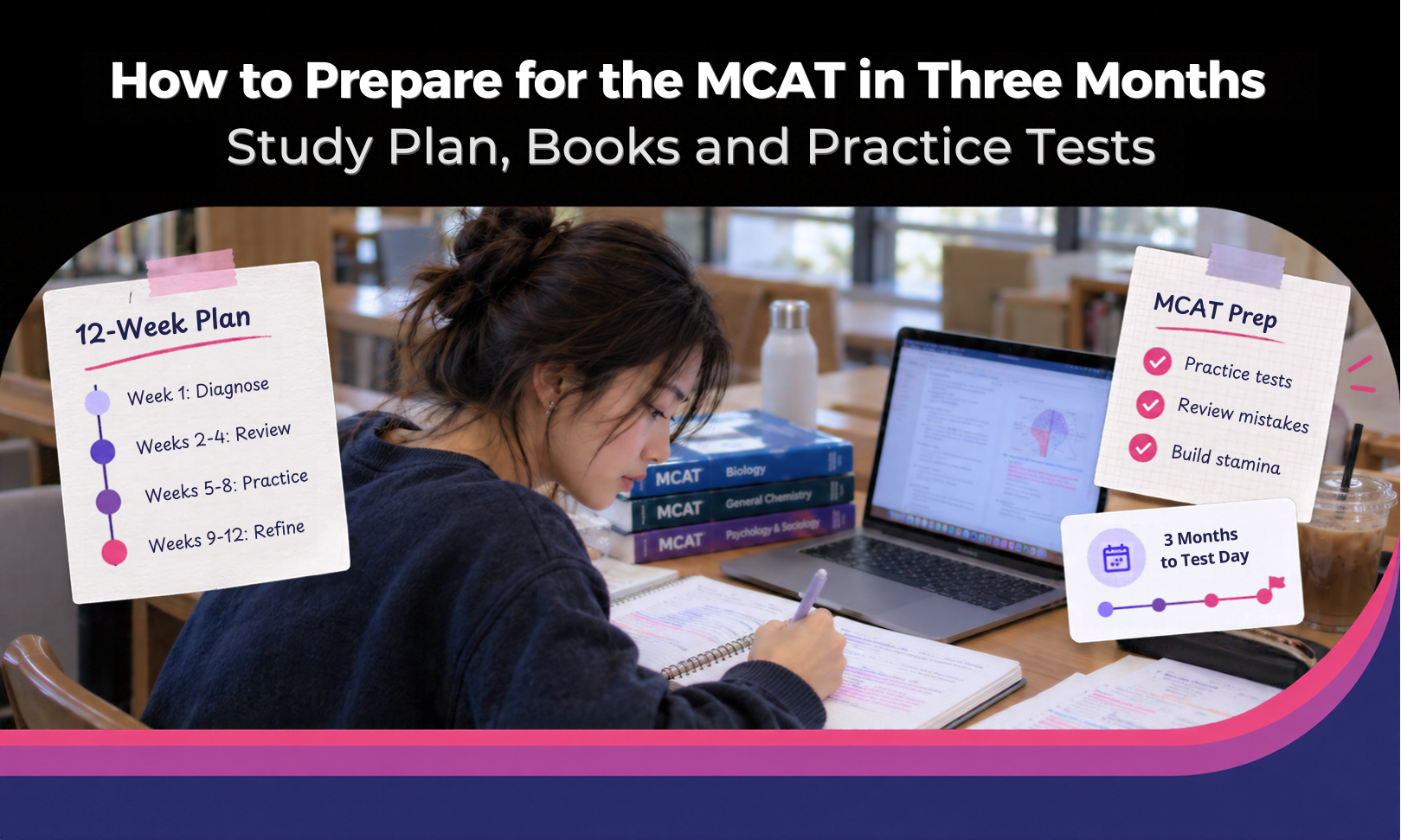

Learn how to structure a 12-week MCAT study plan, balance content review with practice questions, choose useful prep books and build towards full-length practice tests.
Three months can be enough time to make meaningful progress on the MCAT, but it is not automatically the right preparation period for every student.
Your starting point matters.
A student who has recently completed biology, biochemistry, chemistry, physics, psychology and sociology courses may be able to spend most of a 12-week plan refining application and test-taking skills.
Someone returning to science after several years, or learning major parts of the content for the first time, may need longer.
The AAMC recommends building MCAT preparation around your schedule, existing understanding of the tested content and the concepts you still need to learn and practise applying.
For Singapore students balancing university, work and medical-school applications, the aim of a three-month plan should therefore not be to “finish everything”.
It should be to identify what matters most, use practice to expose your weaknesses and adjust your preparation as your performance changes.
Is Three Months Enough to Prepare for the MCAT?
For some students, yes.
But the answer depends on three things:
- Your current knowledge
- Your target score
- How much consistent study time you can realistically protect each week
Icon Education's current MCAT guidance notes that many students begin preparing around four to six months before the exam, although preparation time depends on academic background and target score.
That does not mean a three-month plan cannot work.
It means a 12-week plan needs to be more focused.
If your diagnostic assessment shows major gaps across several science subjects, postponing the test may be more sensible than forcing those gaps into an unrealistic timeline.
On the other hand, if your foundations are reasonably strong and the main challenge is applying knowledge under MCAT conditions, three months can provide a clear structure for moving from review into increasingly realistic practice.
Step 1: Understand What the MCAT Actually Tests
Before building a study schedule, make sure you understand what falls within the exam.
The current MCAT has four sections:
- Chemical and Physical Foundations of Biological Systems
- Critical Analysis and Reasoning Skills
- Biological and Biochemical Foundations of Living Systems
- Psychological, Social, and Biological Foundations of Behavior
The AAMC's official content outline organises the exam around foundational concepts, content categories and the reasoning skills candidates are expected to apply.
This is important because the MCAT is not simply a memory test.
In the science sections, you need to combine content knowledge with:
- scientific reasoning;
- problem-solving;
- research interpretation; and
- data-based reasoning.
CARS focuses instead on:
- comprehension;
- reasoning within a passage; and
- reasoning beyond the text.
If you start preparation by reading textbooks from beginning to end without first understanding these skills, you may spend too much time memorising information and too little time learning how to use it.
Step 2: Take a Baseline Assessment
Your first week should establish where you are starting.
The AAMC recommends using its free Unscored Sample Test to establish baseline knowledge and then reviewing the Content & Skills Breakdown to identify knowledge gaps.
The goal of a diagnostic is not to predict your final score.
Instead, ask:
- Which sections feel strongest?
- Where are the biggest content gaps?
- Do I struggle more with knowledge or application?
- Am I running out of time?
- Is CARS significantly weaker than the science sections?
- Are there particular subjects that repeatedly create problems?
For example, two students may both perform poorly in Chemical and Physical Foundations.
One may genuinely lack physics knowledge.
The other may know the equations but struggle to interpret experimental setups and decide which information matters.
Those students should not follow the same study plan.
Icon's MCAT preparation also begins with diagnostic assessment, followed by personalised coaching and progress tracking.
This is useful because your 12-week plan should reflect your own gaps rather than a generic calendar copied from somebody else's preparation.
A 12-Week MCAT Study Plan
The following is an example structure, not an official AAMC timetable.
You should adjust it based on your baseline assessment.
|
Stage |
Weeks |
Main focus |
|
Diagnose and organise |
Week 1 |
Baseline test, identify gaps, set target and build schedule |
|
Build foundations |
Weeks 2–4 |
Targeted content review + daily application questions |
|
Apply and integrate |
Weeks 5–7 |
Mixed passages, section practice and regular CARS |
|
Build test performance |
Weeks 8–9 |
Timed sections + full-length practice |
|
Refine weaknesses |
Weeks 10–11 |
Full-length tests, deep review and targeted correction |
|
Final preparation |
Week 12 |
Light targeted review, pacing, confidence and test-day preparation |
The most important feature of this plan is the shift in emphasis.
Early weeks contain more content review.
Later weeks contain more test-style application and full-length practice.
You should not reach Week 10 still spending most of your time passively reading chapters.
Weeks 1–4: Build the Foundations
Week 1: Diagnose Before You Review
During the first week:
- review the AAMC content outline;
- complete a diagnostic or baseline test;
- identify low-, medium- and high-confidence topics;
- create a realistic weekly schedule;
- establish your target score based on your medical-school shortlist.
The AAMC's own study-planning guidance suggests categorising content areas according to confidence after reviewing baseline performance.
This prevents a common mistake:
spending equal time on every subject because the MCAT contains every subject.
If your biology is already strong but physics is repeatedly causing mistakes, equal allocation would be inefficient.
Weeks 2–4: Target Content Review
The next stage should focus on the content that your diagnostic identified as weak.
But avoid turning three weeks into passive reading.
A productive content session might look like:
Review → recall → practise → review errors
For example:
- Review a weak biochemistry topic.
- Close the book and explain the concept from memory.
- Complete MCAT-style questions involving that concept.
- Analyse why each incorrect answer was wrong.
- Record any remaining weakness for later review.
Active learning matters because AAMC preparation guidance specifically recommends recall, practice and reflection rather than relying only on reading or watching videos.
How to Prepare for Each MCAT Section
Your schedule should include all four sections throughout the three months rather than studying them one at a time and forgetting earlier material.
Chemical and Physical Foundations
This section draws on concepts including:
- general chemistry;
- organic chemistry;
- physics;
- biochemistry; and
- biology.
Do not focus only on equations.
Practise recognising:
- what variables matter;
- what relationships a graph shows;
- which equation applies;
- whether units can help solve the problem; and
- what information in a passage is unnecessary.
A strong science foundation helps, but the MCAT requires you to apply that foundation in unfamiliar situations.
Critical Analysis and Reasoning Skills
CARS should appear in your study schedule from the beginning, not only during the final weeks.
Because CARS does not depend on memorising a science syllabus, improvement comes largely from learning to:
- identify the main idea;
- understand an author's reasoning;
- separate evidence from interpretation;
- evaluate competing answers; and
- avoid importing outside assumptions into a passage.
Regular smaller practice sessions are often more useful than ignoring CARS for several weeks and then attempting to fix it all at once.
For the 2027 testing year, AAMC has also introduced a consolidated CARS Question Bank, which contains current and newly released CARS practice material.
Use official CARS questions as a reference for question style, but the important step remains reviewing why your reasoning differed from the best-supported answer.
Biological and Biochemical Foundations
This section requires knowledge from areas such as:
- biology;
- biochemistry;
- general chemistry; and
- organic chemistry.
Strong memorisation can help with foundations, but passage interpretation is equally important.
Practise linking biological mechanisms to experimental results rather than studying processes as isolated facts.
For example, instead of simply memorising an enzyme pathway, ask:
- What happens if one step is inhibited?
- What would change on a graph?
- What result would support or contradict a hypothesis?
- Which experimental control would be appropriate?
This type of thinking more closely reflects the reasoning demands of the exam.
Psychological, Social, and Biological Foundations
Students sometimes underestimate this section because the terminology can appear easier to memorise than chemistry or biochemistry.
However, the MCAT also asks you to apply behavioural and social science concepts to research, populations and health-related scenarios.
Your review should therefore combine:
- terminology;
- psychological theories;
- sociology concepts;
- research design; and
- interpretation of data.
Use practice questions to distinguish between concepts that appear similar but have different meanings in context.
Weeks 5–7: Shift From Content Review to Application
By the second month, practice should occupy a larger proportion of your preparation.
You may still review weak topics, but the question becomes:
“Can I use this knowledge in an MCAT passage?”
rather than:
“Have I read this chapter?”
Use Mixed Practice
At this stage, avoid completing only questions from the topic you studied immediately beforehand.
Mixed practice forces you to identify which concept applies without being told in advance.
This more closely resembles the actual exam.
Keep an Error Log
For each meaningful mistake, record:
- section;
- topic;
- question type;
- why you chose your answer;
- why the correct answer is better;
- whether the problem was content, reasoning or timing; and
- what you will do differently.
Over time, patterns matter more than isolated mistakes.
For example:
“I repeatedly misinterpret experimental controls.”
is more actionable than:
“I got Question 37 wrong.”
Track More Than Percentage Correct
A score can tell you whether you improved.
It cannot always tell you why.
Also track:
- time per passage;
- types of errors;
- confidence;
- recurring weak concepts;
- performance when tired; and
- whether changes in strategy are helping.
Icon's MCAT programme specifically includes structured practice, personalised feedback and progress tracking, allowing preparation plans to evolve with performance.
This same principle should guide independent study as well.
Weeks 8–11: Make Practice Tests the Centre of Preparation
Full-length practice tests become increasingly important during the final month.
The AAMC currently provides:
- two free full-length practice exams; and
- five additional low-cost official practice exams.
Each full-length exam contains 230 questions, and the scored official exams reproduce the look, functionality, scaled scoring and percentile reporting of the actual test.
However, taking more practice tests is not automatically better.
The value comes from what happens between them.
Do Not Take Full-Length Tests Back-to-Back Without Review
AAMC guidance recommends thoroughly reviewing incorrect and flagged questions and spending time between practice exams addressing the weaknesses identified.
A productive cycle might be:
Full-length exam → detailed review → targeted study → section practice → next full-length exam
Rather than:
Exam → exam → exam → hope the score rises
Recreate Test Conditions
When taking a full-length practice exam:
- start at a realistic time;
- use the official timing;
- take only permitted breaks;
- avoid your phone;
- do not pause to look up answers;
- practise eating and drinking during breaks;
- work through fatigue rather than ending early.
The MCAT is a long examination.
Stamina and pacing are part of performance.
How Should You Use MCAT Practice Questions?
Practice questions should serve different purposes at different stages.
Early Stage
Use questions to learn how concepts are tested.
Speed matters less.
Middle Stage
Use mixed question sets to identify gaps and improve application.
Begin introducing time pressure.
Final Stage
Use realistic timed sections and full-length exams to practise performance under testing conditions.
The AAMC also provides subject-specific question packs, Section Banks and an Independent Question Bank covering biology, chemistry, physics, biochemistry, psychology and sociology.
You do not need to complete every available question simply because it exists.
Choose practice based on the weaknesses identified in your diagnostic and ongoing review.
Which MCAT Prep Books Should You Use?
MCAT books can be useful for structured content review, particularly during the first month of a three-month plan.
However, buying several complete book sets often creates more work rather than better preparation.
A good book should help you:
- organise content clearly;
- identify the concepts that matter;
- review difficult topics efficiently;
- test your understanding; and
- connect content with MCAT-style application.
Use the AAMC Content Outline as Your Checklist
Whichever book or publisher you use, compare it with the official What's on the MCAT Exam? Content Outline.
The AAMC outline defines the concepts, categories and skills candidates are responsible for on test day.
This prevents a commercial textbook from becoming your syllabus by default.
What About Kaplan MCAT Books?
Kaplan currently offers a MCAT Complete 7-Book Subject Review 2027–2028 set covering behavioural sciences, biochemistry, biology, general chemistry, organic chemistry, physics and CARS. It also includes practice and digital resources.
For some students, a structured set like this can be useful for content review.
However, that does not mean you need to read all seven books from beginning to end during a three-month plan.
A better approach is to use your diagnostic results to decide which books or chapters deserve the most attention.
For example:
- strong biology + weak physics → spend far more time in physics;
- strong sciences + weak CARS → content books may be a lower priority;
- broad gaps across multiple sciences → three months may be too compressed.
The book should support your plan.
Your plan should not be built around finishing the book.
Do You Need Expensive MCAT Preparation Resources?
Not necessarily.
AAMC currently provides several free resources, including:
- the MCAT content outline;
- the Unscored Sample Test;
- Practice Exam One;
- practice questions;
- exam-feature familiarisation; and
- links to Khan Academy MCAT content.
The AAMC content-outline course also includes 120 free practice questions, while the Khan Academy MCAT collection contains extensive video and review material.
Paid question banks, books and courses can still be useful, but they should solve a specific preparation problem.
Ask:
- Do I need clearer content explanations?
- Do I need more practice?
- Do I need feedback?
- Do I need accountability?
- Do I need help identifying why my score is not improving?
More resources are not automatically better.
Three months is a limited period, so resource overload can become a genuine disadvantage.
A Sample Weekly MCAT Study Structure
How many hours you need will depend on your background and other commitments, so there is no single correct weekly total.
A useful weekly structure might look like:
During Weeks 2–7
Day 1
Targeted science content + practice questions
Day 2
CARS + biology/biochemistry application
Day 3
Psychology/sociology + mixed questions
Day 4
Chemistry/physics + passage practice
Day 5
CARS + weakest content area
Day 6
Longer mixed practice + error review
Day 7
Rest or light review
During Weeks 8–11
One study day may instead become a full-length test, followed by a dedicated review session.
The exact calendar matters less than consistency and feedback.
A schedule that looks impressive on paper but cannot be sustained for 12 weeks is not a good schedule.
How Should You Review a Full-Length MCAT Practice Test?
This is one of the most important parts of preparation.
Do not review only the questions you answered incorrectly.
Also review:
- correct answers you guessed;
- questions where you were unsure;
- questions that took too long; and
- passages where your reasoning was inefficient.
For each one, ask:
What did I know?
What did I miss?
What clue should I have noticed?
Was the problem knowledge, reasoning or timing?
How will I prevent the same mistake next time?
One full-length test reviewed deeply can teach you more than several tests completed without analysis.
Week 12: What Should You Do in the Final Week?
The final week should not be used to relearn the entire MCAT syllabus.
Focus on:
- recurring weaknesses;
- essential formulas or concepts;
- CARS consistency;
- light timed practice;
- reviewing your error log;
- test-day logistics; and
- maintaining sleep and routine.
Avoid taking a large number of new full-length exams at the last minute.
You want to arrive at the actual MCAT familiar with the process and mentally prepared, not exhausted from trying to squeeze in every remaining resource.
Candidates taking the MCAT in 2027 should also read the current MCAT Essentials for Testing Year 2027, which contains the policies and procedures applicable to registration and test day.
Common Questions About Preparing for the MCAT in Three Months
Can I really prepare for the MCAT in three months?
Potentially, yes.
Three months can work when your academic foundations are reasonably strong and you can study consistently.
If your diagnostic shows major gaps across several subjects, extending your preparation timeline may produce a better outcome than trying to rush through everything.
Should I study content or do practice questions first?
You need both.
Early preparation may contain more content review, particularly in weak subjects.
As the exam approaches, your study should increasingly focus on applying that content through MCAT-style questions, timed sections and full-length practice.
How many full-length practice tests should I take?
There is no universal number.
The AAMC currently offers seven official full-length options in total: two free and five low-cost exams.
The better question is whether you have enough time to review each test thoroughly and improve before the next one.
Are MCAT prep books worth it?
They can be useful for organising content review, especially if you prefer structured explanations.
However, you do not need multiple overlapping book sets.
Choose a resource that fits your knowledge gaps and use the AAMC content outline to keep your review aligned with the exam.
Are Kaplan MCAT books good for preparation?
Kaplan currently publishes a seven-book 2027–2028 MCAT subject-review set covering the major content areas and CARS.
It can be one option for structured content review, but no commercial book set should replace official MCAT-style practice or personalised attention to your weaknesses.
Should I use AAMC practice tests at the beginning or end?
Both can be useful at different stages.
The AAMC recommends its free Unscored Sample Test as a baseline tool. Later, scored official exams can be used under realistic timing conditions to assess progress and refine test-day strategy.
What if my practice scores are not improving after six weeks?
Do not automatically respond by studying more hours.
Review why the score is stagnant.
Possible causes include:
- unresolved content gaps;
- weak passage analysis;
- poor timing;
- ineffective CARS strategy;
- insufficient error review;
- fatigue; or
- using the same study method despite repeated weaknesses.
If you cannot identify the problem yourself, this is where external diagnostic feedback can be useful.
How Can Icon Support a Three-Month MCAT Plan?
Three months is long enough to make meaningful progress, but short enough that inefficient preparation can cost valuable time.
Icon Education's current MCAT support is built around four areas:
Diagnostic Assessment
Icon begins by identifying a student's current level and the areas requiring the greatest attention before the exam.
For a three-month timeline, this is particularly important because there is less room to spend several weeks discovering that your original study plan focused on the wrong areas.
Personalised Coaching
Icon provides one-to-one coaching tailored to academic background, target score and preferred medical schools.
This allows two students with the same test date to follow different preparation priorities.
For example:
- a science graduate may need more support with CARS;
- a student returning to science may need structured content review;
- another student may already know the content but need better timing and passage strategy.
Strategic Test Preparation
Icon's MCAT preparation focuses on managing complex questions, applying scientific knowledge and performing effectively under timed conditions.
This matters because the second half of a three-month plan should increasingly shift from learning content to performing under MCAT conditions.
Practice and Progress Tracking
Icon currently describes its preparation as including:
- structured practice;
- personalised feedback;
- online progress reports;
- proprietary online content; and
- full-length practice tests with diagnostics.
Rather than following the same 12-week schedule regardless of performance, the preparation plan can therefore change as weaknesses improve or new ones emerge.
For Singapore students preparing for Duke-NUS or other medical programmes that accept the MCAT, this can also help connect your target score and test date with the wider medical-school application timeline.
A good three-month MCAT plan is not simply a calendar.
It is a cycle:
diagnose → learn → practise → review → adjust → repeat
The more accurately each stage responds to your actual performance, the more useful those 12 weeks become.