
Medical work experience can give you valuable insight into healthcare, but completing the experience is only part of the learning.
What matters is whether you can explain what you noticed, why it mattered and what changed in your understanding.
That is where a medical work experience reflection journal can help.
Medical Schools Council recommends keeping a reflective journal because medical schools are interested not only in what applicants do, but in what they learn from their experiences.
A reflection journal gives you a place to capture those insights while they are still fresh. You can use one after shadowing, volunteering, community service, employment or a simulated medical experience.
The aim is not to write polished application paragraphs immediately. It is to create an honest record of your thinking that you can return to later.
What Should You Record After an Experience?
A useful reflection journal should contain more than a list of activities.
Instead of simply recording:
“Observed a doctor speaking to a patient.”
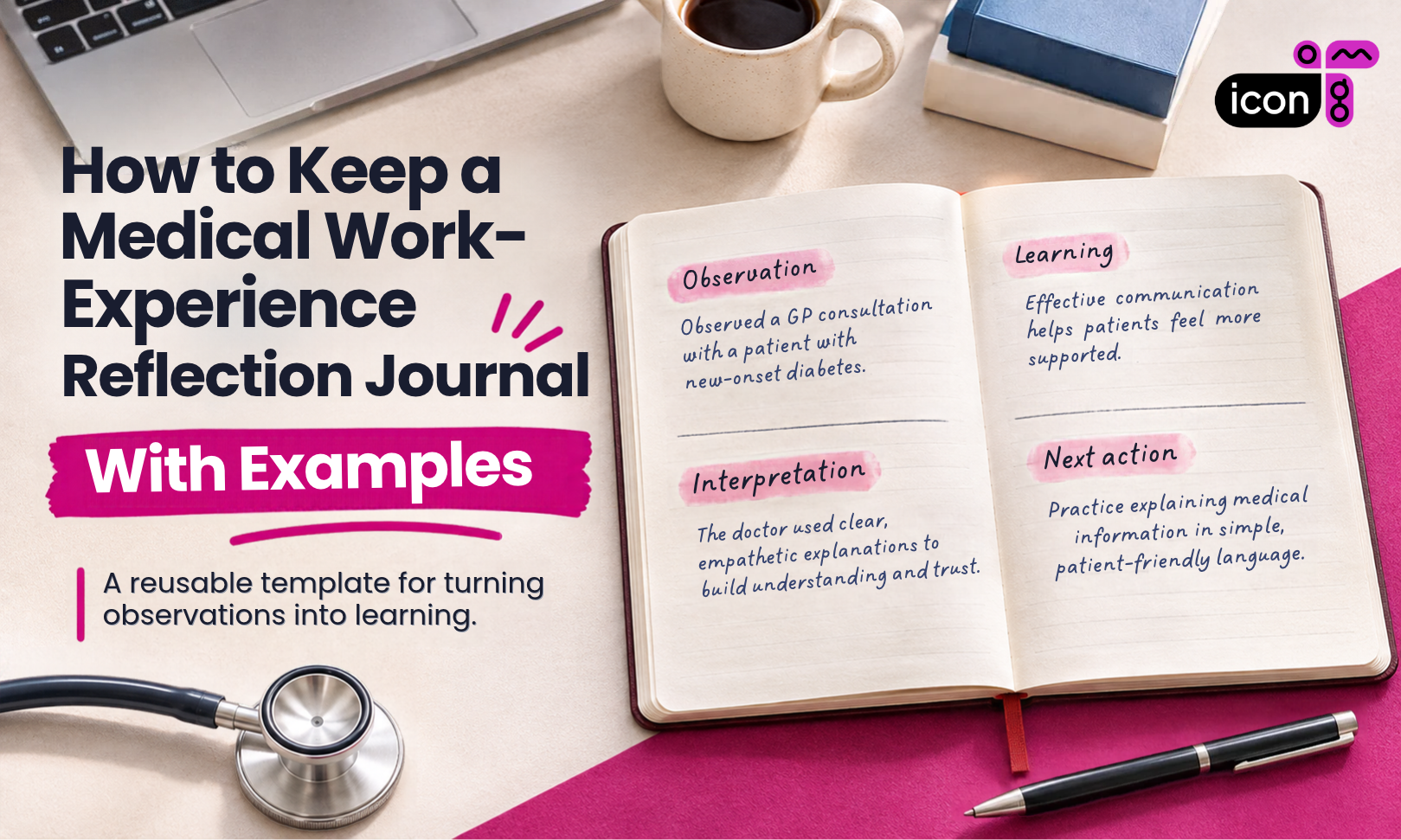
separate the experience into four parts:
- Observation — What did you actually notice?
- Interpretation — Why did it stand out or matter?
- Learning — What did it change or deepen in your understanding?
- Next action — What will you observe, ask, research or do differently next time?
This structure helps prevent your journal from becoming a diary of events.
A Reusable Medical Work-Experience Reflection Journal
|
Section |
Questions to record |
|
Experience |
What type of experience was this: shadowing, volunteering, employment, research or simulation? |
|
Observation |
What specific interaction, decision, challenge or behavior did I notice? |
|
Interpretation |
Why did this stand out? What might explain what happened? |
|
Learning |
What did this teach me about healthcare, other people, myself or Medicine? |
|
Next action |
What will I observe, ask, research or practice next? |
|
Privacy check |
Have I removed names and any details that could identify a patient or service user? |
You do not need to complete a full page after every hour of experience.
A short entry about one meaningful moment can be more useful than a long description of everything that happened.
Imperial College London encourages applicants to keep a reflective diary and consider questions such as what they found challenging, how healthcare professionals communicated and what they learned about Medicine.
The useful principle is simple:
Record moments that changed or challenged your thinking.
What If the Experience Was Simulated?
You can use exactly the same reflection structure after a virtual or simulated experience.
The important point is to describe the format honestly.
If you worked through a fictional clinical case, write:
“During a simulated medical case…”
rather than:
“When treating a patient…”
You can still reflect on reasoning, communication, teamwork or uncertainty. The learning may be meaningful even though no real patient contact took place.
How Does Reflection Differ from Description?
Description tells someone what happened.
Reflection explains why it mattered and what you learned from it.
Compare the following examples.
Fictional Example 1: Shadowing
Description only:
I shadowed a doctor in a clinic and watched them speak to several patients. They explained medical information and answered questions.
This reports what happened, but it does not explain what the student noticed or learned.
Stronger reflection:
While shadowing in a clinic, I noticed that the doctor changed the way they explained similar information depending on each patient’s questions and level of understanding. I had previously thought good communication mainly meant explaining information clearly. The experience showed me that it also involves checking what another person understands and adapting the explanation accordingly. In future healthcare-related experiences, I want to pay closer attention to how professionals confirm understanding.
The reflection identifies a specific observation and shows how the student’s thinking changed.
Fictional Example 2: Volunteering
Description only:
I volunteered at a community center for elderly residents. I helped with activities and spoke to participants.
Again, this tells us what the student did but not what they learned.
Stronger reflection:
During a community activity, I noticed that one participant did not want to join the group immediately. The volunteer coordinator spoke with them privately instead of repeatedly encouraging them to participate. This made me realize that helping someone does not always mean trying to involve them straight away. Sometimes it means asking what they are comfortable with and allowing them to decide. In future volunteering sessions, I would first ask what kind of support the person would find useful.
This version sounds more like genuine reflection than a polished application answer.
Fictional Example 3: Simulated Medical Experience
Description only:
I completed an online medical case and discussed possible explanations with my group.
Stronger reflection:
During a simulated medical case, I initially focused on reaching a conclusion quickly. Another student pointed out that several important pieces of information were still missing. I realized that I had started treating an assumption as if it were a confirmed fact. The exercise showed me that careful reasoning sometimes means delaying a conclusion until enough evidence is available. In my next simulated case, I would separate confirmed information from assumptions before suggesting an explanation.
This example also makes the nature of the activity clear: it was simulated, not real patient care.
How Can You Connect an Observation to Your Learning?
One common problem in reflective writing is jumping directly from an event to a broad statement.
For example:
“I saw teamwork in the hospital, so I learned that teamwork is important.”
The conclusion may be true, but it does not show much thinking.
Ask one more question:
What exactly showed you that teamwork mattered?
Perhaps a doctor asked a nurse for additional information before making a decision.
Perhaps responsibilities were divided between several healthcare professionals.
Perhaps someone raised a concern that changed the team’s next step.
Those details give you something meaningful to analyze.
A simple four-step process can help.
1. Identify the Moment
Choose one specific observation.
A healthcare professional paused to clarify information with another team member.
2. Ask Why It Mattered
What effect did that behavior have?
It reduced uncertainty before the team moved forward.
3. Connect It to a Wider Insight
What did the moment teach you?
Effective teamwork is not simply dividing tasks. It also involves communicating uncertainty and checking information with others.
4. Identify Your Next Action
What will you do with that insight?
In future experiences, I will pay attention to how team members raise concerns and ask for clarification when they are unsure.
This process keeps your reflection grounded in something you actually observed.
It also gives you useful evidence if you later need to discuss the experience in an interview or application.
UCL notes that applicants’ reflections on work experience may be assessed at interview, which is another reason to record your thinking while the details are still fresh.
If you later decide to turn selected reflections into application writing, Icon Education’s Medicine Personal Statement guide discusses how experiences can contribute to a wider application narrative.
Your reflection journal should come before that stage.
Do not try to make every entry sound impressive. Record what you genuinely noticed first. You can decide later whether it belongs in an application.
What Details Must Stay Private?
Reflection should never depend on recording information that could identify a patient or service user.
GMC guidance states that reflective notes should be anonymized as much as possible. Removing a name alone may not be enough because combinations of details can still identify someone.
A useful rule is:
Record the lesson, not the identity of the person involved.
Avoid recording unnecessary details such as:
- a patient’s name or initials;
- date of birth;
- home address;
- phone number or email;
- hospital or identification numbers;
- photographs or screenshots;
- exact appointment details when they are not needed;
- combinations of highly specific information that could make someone identifiable.
Even without a name, a person may still be recognizable if you record an unusual condition, exact age, specific location and other distinctive circumstances together.
You usually do not need those details to reflect effectively.
Instead of writing:
“A 67-year-old patient named Mr ___ attended Clinic X on 14 October because…”
write something like:
“During a clinical observation, I noticed how a healthcare professional explained unfamiliar information to a patient who appeared anxious.”
The second version keeps the learning point while removing unnecessary identifying information.
What About Shadowing Notes?
If you are shadowing a doctor, focus on themes such as:
- communication;
- teamwork;
- professionalism;
- managing uncertainty;
- patient autonomy;
- emotional demands;
- time management;
- the realities of clinical work.
Icon Education’s How to Ask to Shadow a Doctor provides broader guidance on arranging and making the most of shadowing opportunities.
For your journal, however, focus on what the experience taught you rather than recording patient details.
A Quick Privacy Check
Before saving an entry, ask:
- Have I included any names or direct identifiers?
- Could the combination of details identify someone?
- Do I actually need this clinical detail to explain what I learned?
- Can I make the observation more general without losing the reflection?
- If the experience was simulated, have I clearly described it as simulated?
If you are unsure, remove the unnecessary detail.
Final Takeaway
A medical work-experience reflection journal is not simply a record of how many hours you completed or how many activities you observed.
Its purpose is to capture the thinking that can otherwise disappear a few weeks later.
After each meaningful experience, use:
Observation → Interpretation → Learning → Next action
Keep each entry specific, honest and anonymous.
Do not force every experience into a positive lesson. Some of the most useful reflections may come from uncertainty, disagreement or something that challenged your previous assumptions.
Over time, your journal can give you a clearer record of how your understanding of Medicine has developed — and why.
For students who want support turning their own reflections into a clear and authentic application narrative, Icon Education provides personalized personal-statement coaching.
Get help turning your own reflections into a clear application narrative.