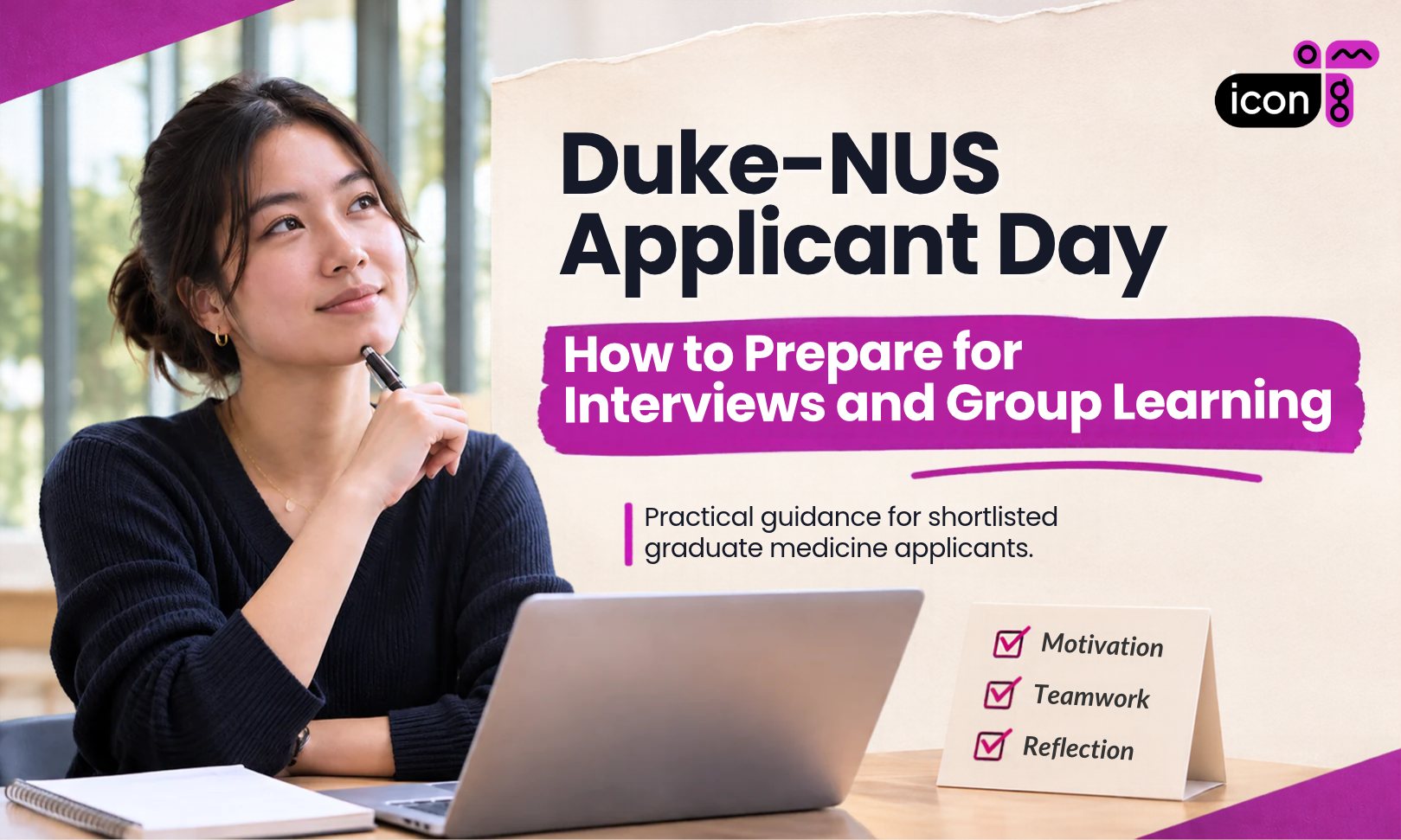
Being invited to a Duke-NUS Applicant Day means your application has progressed to the stage where the school can learn more about you beyond your written materials.
It is also an opportunity for you to learn more about Duke-NUS.
For the current admissions cycle, Duke-NUS states that shortlisted applicants receive an email invitation with details of the day’s program approximately one to two weeks in advance. Applicant Days are held mainly at the Duke-NUS campus in Singapore, with a smaller number conducted in the United States.
Interviews take place on the same day and are used to assess an applicant’s suitability for admission.
Duke-NUS does not currently publish a separate group-learning assessment as part of Applicant Day. The collaborative exercises in this guide are preparation activities informed by the school’s team-based learning environment, not predictions of the official assessment format.
This guide focuses specifically on Duke-NUS Applicant Day preparation after shortlisting: what is officially confirmed, how to explain your transition into Medicine, how to practice collaborative thinking and how to review your preparation.
For the wider application process, see Icon Education’s How to Get into Duke-NUS Medical School.
What Is Confirmed for the Current Duke-NUS Applicant Day?
Duke-NUS describes Applicant Day as an opportunity for the school and applicant to learn more about each other.
Current official information confirms that:
- shortlisted applicants are invited by email;
- the detailed program is normally provided 1–2 weeks before Applicant Day;
- most Applicant Days take place at Duke-NUS in Singapore;
- a smaller number are held in the United States;
- applicants have opportunities to meet faculty and students;
- interviews are conducted on the same day.
Duke-NUS currently publishes Applicant Day dates across the 2026–27 admissions cycle, with Singapore sessions continuing into April 2027. Because dates may change, applicants should rely on their own invitation and the current Duke-NUS application page for the latest schedule.
The school does not currently publish every Applicant Day activity or a fixed interview format in advance.
That means you should be careful about preparing from older articles, forum discussions or previous-cycle experiences.
A format used in a previous year should not automatically be treated as current.
Duke-NUS does, however, identify qualities it considers important in applicants, including:
- communication and interpersonal skills;
- integrity;
- teamwork;
- altruism;
- resilience;
- critical thinking.
Duke-NUS also uses TeamLEAD, its team-based learning approach, within the medical curriculum.
TeamLEAD involves preparation, problem-solving, discussion and collaborative learning. Duke-NUS does not state that TeamLEAD itself is assessed during Applicant Day. It is relevant here because it provides context for the collaborative learning environment students enter after admission.
How Should You Explain Your Transition into Medicine?
Duke-NUS is a graduate-entry medical school, so applicants arrive after completing or progressing through a bachelor’s degree.
Your previous academic or professional path therefore does not need to look like a mistake that you are trying to correct.
A stronger explanation shows how your earlier experiences contributed to your decision to pursue Medicine.
A useful structure is:
Previous path → developing interest → evidence → why Medicine now
1. Explain Your Previous Path
Briefly explain what you previously chose to study or do and why.
For example:
“I studied engineering because I was interested in problem-solving and how technical systems could improve people’s lives.”
This provides context without apologizing for not choosing Medicine earlier.
2. Explain How Your Interest Developed
Identify the experiences that made Medicine increasingly relevant to you.
These might include:
- research;
- volunteering;
- clinical exposure;
- employment;
- caregiving;
- public-health work;
- another meaningful experience.
Your decision does not need to come from one dramatic moment.
For many applicants, the motivation for Medicine develops gradually.
3. Provide Evidence
Avoid stopping at:
“I realized Medicine was my passion.”
Explain what you did after your interest developed.
For example:
“My interest became more concrete after volunteering in a healthcare setting and later contributing to research involving patient outcomes.”
Actions make your motivation easier to understand.
4. Explain Why Medicine Now
Connect those experiences to the decision you are making today.
You should be able to explain why becoming a doctor fits your goals better than simply continuing along your previous path.
Duke-NUS describes its MD program through the Clinicians Plus vision, in which graduates can combine clinical practice with other capabilities as scientists, innovators, educators or leaders.
You do not need to force yourself into one category. Instead, think about how your previous background might contribute to the type of physician you want to become.
Follow-Up Questions to Practice
Once you can explain your transition clearly, ask someone to challenge it with questions such as:
- Why did you not pursue Medicine earlier?
- Why become a doctor instead of remaining in your current field?
- Which part of your previous degree or career will still matter in Medicine?
- What have you done to test whether Medicine is right for you?
- Why Duke-NUS?
- How has your motivation changed since you first considered Medicine?
The objective is not to memorize six perfect answers.
It is to make sure your career decision remains coherent when someone asks you to explain it from another angle.
For guidance on developing the written version of this narrative, see Icon Education’s Duke-NUS Personal Statement Guide.
How Can You Demonstrate Collaborative Thinking?
Good collaboration is not the same as speaking the most.
Duke-NUS identifies teamwork, communication and critical thinking among the qualities it considers in applicants, while its TeamLEAD curriculum emphasizes collaborative problem-solving and discussion.
When practicing collaborative thinking, focus on behaviors such as:
- understanding the task before proposing a solution;
- explaining your reasoning clearly;
- listening to other viewpoints;
- asking useful questions;
- building on another person’s idea;
- recognizing assumptions;
- changing your position when stronger reasoning appears;
- helping the group reach a decision without dominating it.
Original Teamwork Practice Exercise
The exercise below is an Icon-created preparation activity. It is not a recalled or predicted Duke-NUS Applicant Day task.
Your group is advising a community health organization that has funding for only two of the following initiatives:
- free health-screening sessions for older adults;
- a mental-health support program for university students;
- mobile health education for lower-income communities;
- a digital tool that helps patients remember medication schedules.
Your group has 10 minutes to choose two initiatives and explain the reasoning behind the decision.
There is no single correct answer.
The purpose is to practice discussing competing priorities with other people.
After the Exercise, Ask:
- Did I understand the objective before giving my opinion?
- Did I listen to other viewpoints?
- Did I explain my reasoning rather than simply state a preference?
- Did I help the group move toward a decision?
- Did I adapt when someone presented a stronger argument?
A useful participant does not need to control the discussion.
Sometimes the strongest contribution is recognizing where two viewpoints overlap, clarifying the disagreement and helping the group identify a practical next step.
How Should You Review Your Applicant Day Preparation?
Preparation becomes more useful when you review patterns rather than completing more and more random interview questions.
Use the following checklist before Applicant Day.
Duke-NUS Applicant Day Preparation Checklist
|
Area |
What to check |
|
Official information |
I have checked my invitation and the current Duke-NUS Applicant Day information. |
|
Application recall |
I can discuss the important experiences, research and activities in my application. |
|
Motivation |
I can explain why I am pursuing Medicine without relying on a memorized slogan. |
|
Career transition |
I can connect my previous academic or professional path to my decision to pursue Medicine. |
|
Duke-NUS fit |
I understand the Clinicians Plus vision and the general TeamLEAD learning approach. |
|
Examples |
I have specific experiences that demonstrate teamwork, resilience, communication and reflection. |
|
Follow-up questions |
I can respond when someone challenges an assumption in my first answer. |
|
Collaborative thinking |
I can listen, contribute and adapt when discussing a problem with others. |
|
Questions for Duke-NUS |
I have genuine questions that will help me evaluate whether the school fits my goals. |
|
Logistics |
I have checked the date, location, arrival instructions and required materials in my invitation. |
Review Your Mock Interviews
After a mock interview, avoid simply asking:
“Was my answer good?”
Instead, identify something observable.
|
Too general |
More useful review |
|
“I sounded nervous.” |
“I rushed my explanation of why I changed careers and skipped the evidence supporting that decision.” |
|
“My teamwork answer was weak.” |
“I described what the group achieved but did not explain my own contribution.” |
|
“My Duke-NUS answer was too generic.” |
“I mentioned TeamLEAD but did not explain why collaborative learning suits the way I learn.” |
Then choose one change for the next practice session.
For example:
- give a more specific example;
- answer the question before adding background;
- pause before responding;
- explain an assumption;
- acknowledge another perspective;
- connect an experience more clearly to your career decision.
This gives each mock interview a specific purpose rather than simply increasing the number of questions you complete.
Final Takeaway
Duke-NUS Applicant Day is an opportunity for the school to understand you beyond your academic results and written application — and for you to learn more about the medical school.
For the current admissions cycle, Duke-NUS publicly confirms that shortlisted applicants attend Applicant Day, have opportunities to meet members of the school community and complete interviews on the same day.
The school does not currently publish a separate group-learning assessment or every activity that may appear during the day.
That means your preparation should focus less on predicting a hidden format and more on what you can control.
Be ready to explain:
where you came from → how your interest in Medicine developed → what evidence supports that decision → why Duke-NUS fits your direction
At the same time, practice listening, explaining your reasoning and adapting when another person introduces a stronger argument or new information.
Those skills are useful in interview preparation and in the collaborative learning environment students later encounter at Duke-NUS.
Practice explaining your experiences and motivation with an Icon coach.