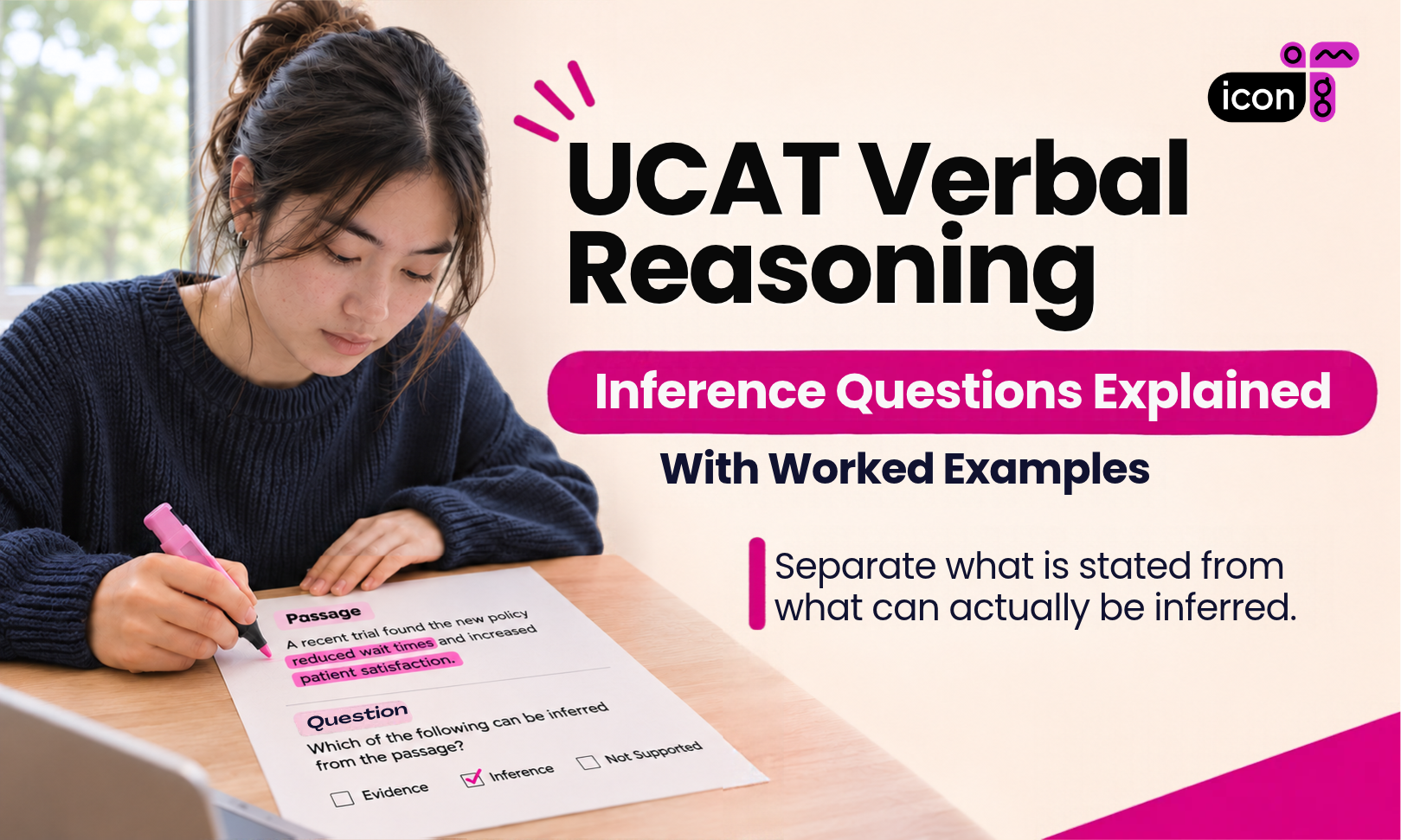

A statement can sound reasonable and still not be supported by the passage.
That is one of the central challenges in UCAT verbal reasoning inference questions.
You may understand the topic, recognize familiar information and even agree with an answer based on your own knowledge. But if the passage does not provide enough evidence for that conclusion, the answer may still be wrong.
Current format note: As of November 2026, UCAT lists Verbal Reasoning as 44 questions in 22 minutes. UCAT states that its current preparation information applies to the 2026 testing cycle and may change for 2027, so candidates should recheck the official format when updated information is released.
There is also no single reading technique that every candidate must use. Different approaches may work for different people.
This tutorial therefore focuses on one transferable skill:
separating what the passage states from what the evidence actually allows you to infer.
A useful practice framework is to separate information into three categories:
stated → supported inference → unsupported assumption
The original passages below are designed to help you practice that distinction.
All passages and questions in this article were created for instructional practice. They are not official UCAT questions, recalled test material or predictions of future questions.
What Is Stated Versus Inferred?
Start with three simple categories.
Stated
The information appears directly in the passage.
Inferred
The conclusion is not written word-for-word, but it follows from the information provided.
Assumed
The conclusion may sound plausible, but the passage does not provide enough evidence to justify it.
Consider the following original passage.
Original Passage 1: Library Opening Hours
A city library extended its Saturday closing time from 2 p.m. to 6 p.m. for a 12-week trial. During the trial, average Saturday visits increased from 320 to 410. In a survey of 180 visitors, 62% said that the later closing time made visiting the library easier. The library has not yet decided whether the extended hours will become permanent.
Now evaluate each statement.
Statement 1
Average Saturday visits were higher during the trial than before it.
Answer: True
The passage directly states that average visits increased from 320 to 410.
The evidence is explicit.
Statement 2
The extended opening hours caused the entire increase in Saturday visits.
Answer: Can’t Tell
The passage tells us two things:
- the closing time was extended;
- average visits increased.
It does not prove that the change in hours caused the entire increase.
Other factors may have affected attendance.
The tempting reasoning is:
hours changed → visits increased → the change caused the increase.
The first two points are stated.
The final causal link is an assumption.
Statement 3
Most surveyed visitors said that the later closing time made visiting easier.
Answer: True
The passage states that 62% of surveyed visitors agreed.
Because 62% is more than half, the word most is supported.
Statement 4
The library had already decided to make the extended opening hours permanent.
Answer: False
The passage says the opposite:
the library has not yet decided.
This is different from Can’t Tell.
For False, the passage provides information that contradicts the statement.
For Can’t Tell, there is not enough information to decide whether the statement is true or false.
Evidence-Highlighting Exercise
Return to the passage and highlight only the phrases needed to answer the statements:
- “increased from 320 to 410”
- “62% said...”
- “has not yet decided...”
Then notice what you cannot highlight:
evidence proving that the extended hours caused the increase in visitors.
That missing evidence matters.
When practicing UCAT inference questions, ask:
Which exact part of the passage allows me to reach this conclusion?
If you cannot identify it, check whether you have added an assumption.
When Is Evidence Insufficient?
A common inference error is choosing an answer because it is possible rather than because the passage supports it.
Consider another original passage.
Original Passage 2: Study-Skills Workshop
Northfield College offered a voluntary six-week study-skills workshop to first-year students. Eighty of the college’s 500 first-year students chose to attend. At the end of the semester, workshop participants had an average examination mark of 71, while students who did not attend had an average mark of 67. The college did not collect information about the students’ previous grades or the number of hours they studied independently.
Worked Question
Which conclusion is best supported by the passage?
A. The workshop caused participants’ examination marks to increase by four points.
B. Students who attended the workshop achieved a higher average examination mark than students who did not attend.
C. Students who attended the workshop studied harder than students who did not attend.
D. The workshop would improve the examination marks of every first-year student.
Correct Answer: B
The passage directly gives the two averages:
- participants = 71;
- non-participants = 67.
Therefore, the participants achieved the higher average mark.
Why Is A Wrong?
The workshop caused participants’ examination marks to increase by four points.
This changes an observed difference into a causal conclusion.
Students chose whether to attend the workshop, and the passage gives no information about their previous performance.
The evidence shows an association.
It does not establish that the workshop itself caused the difference.
Why Is B Correct?
Students who attended the workshop achieved a higher average examination mark than students who did not attend.
This stays within the evidence.
The passage explicitly reports 71 compared with 67.
No additional explanation for the difference is required.
Why Is C Wrong?
Students who attended the workshop studied harder than students who did not attend.
The passage does not provide information about independent study time.
The answer introduces information that is not available.
It may sound reasonable, but reasonable is not the same as supported.
Why Is D Wrong?
The workshop would improve the examination marks of every first-year student.
The passage describes the students who participated.
It cannot establish what would happen to every student.
The qualifier makes the conclusion much stronger than the available evidence.
Test the Missing Evidence
When an answer seems plausible, ask:
What additional information would I need before I could confidently make this conclusion?
For A, you would need stronger evidence showing that the workshop produced the difference.
For C, you would need information about study behavior.
For D, you would need evidence about the effects of the workshop across the wider student population.
If an answer needs information the passage never provides, treat that as a warning sign.
How Do Qualifiers Change Meaning?
Small words can completely change the strength of a claim.
Pay attention to words such as:
- all;
- some;
- most;
- only;
- always;
- usually;
- may;
- must;
- at least;
- exactly.
These words define the limits of what a sentence actually says.
Original Passage 3: Museum Tours
During winter, the museum’s weekday guided tours are usually available at 11 a.m. and 2 p.m. On public holidays, some tours may be canceled. Visitors who book online at least 24 hours in advance are guaranteed a place on any tour that operates.
Worked Question
Which statement is best supported?
A. All 2 p.m. tours operate on public holidays.
B. A visitor who books online at least 24 hours in advance is guaranteed a place if the selected tour operates.
C. Most public-holiday tours are canceled.
D. Visitors who do not book online cannot join a guided tour.
Correct Answer: B
The final sentence directly establishes two conditions:
- the visitor books online at least 24 hours in advance;
- the selected tour operates.
If both are satisfied, the visitor is guaranteed a place.
Why Is A Wrong?
All 2 p.m. tours operate on public holidays.
The passage says:
some tours may be canceled.
It gives no guarantee that every 2 p.m. tour operates.
Why Is B Correct?
This option preserves all the conditions stated in the passage:
- online
- at least 24 hours in advance
- if the tour operates
Nothing has been added or removed.
Why Is C Wrong?
Most public-holiday tours are canceled.
The passage says:
some tours may be canceled.
Some does not mean most.
The quantity has been changed.
Why Is D Wrong?
Visitors who do not book online cannot join a guided tour.
The passage explains what is guaranteed for people who book online early.
It says nothing about whether other visitors may be able to join.
A guarantee for one group does not automatically establish a prohibition for everyone else.
A Quick Qualifier Drill
Compare:
Some tours may be canceled.
with:
Most tours are canceled.
and:
All tours are canceled.
They are not equivalent.
Similarly:
usually ≠ always
may ≠ will
some ≠ most
can ≠ must
Try another example:
Some students reported improvement.
Which statements are supported?
All students reported improvement. ❌
Most students reported improvement. ❌
At least some students reported improvement. ✅
A common inference mistake is remembering the general meaning of a sentence while losing the qualifier that controls its strength.
When highlighting evidence, consider underlining these qualifier words separately.
How Should You Review Repeated Inference Mistakes?
If you repeatedly miss inference questions, recording only the correct answer will not tell you what to change.
Instead, identify the reasoning error.
A Verbal Reasoning Inference Log
| Error type | What happened |
|---|---|
| Outside-knowledge error | I used information I knew rather than evidence in the passage. |
| Causation error | I turned an association into a causal relationship. |
| Qualifier error | I changed words such as “some,” “may” or “usually.” |
| Missing-evidence error | My answer required information the passage did not provide. |
| Overgeneralization | I extended evidence from one group or situation too broadly. |
| Reversal error | I reversed the direction of a relationship. |
| Passage-location error | I missed or misread the sentence containing the evidence. |
| Timing error | I answered before checking whether the passage supported the conclusion. |
Example Review
Suppose you selected:
The workshop caused examination marks to increase.
A weak review would be:
I misunderstood the passage.
A more useful review is:
Error type: Causation error
Evidence: Participants averaged 71 and non-participants averaged 67.
Unsupported step: I assumed the workshop caused the difference.
Next time: When two groups differ, check whether the passage establishes causation or only reports an association.
Now you have a reasoning pattern you can recognize again.
Use Evidence Before Explanation
For every incorrect inference question, record:
1. What did the passage actually state?
2. What did the answer claim?
3. What extra step did I add?
That third question is often where the error becomes visible.
You may discover that you repeatedly:
- add outside knowledge;
- strengthen a qualifier;
- infer causation;
- generalize beyond the group described;
- or answer before locating the evidence.
Practice Reasoning and Pace Together
With 44 questions in 22 minutes under the current format, Verbal Reasoning is highly time-pressured.
However, that does not mean every question must take exactly the same amount of time. Reading time is shared across passage sets, and different candidates may use different reading approaches.
The goal is to test whether your own method produces both acceptable pace and accurate reasoning.
Round 1 — Evidence First
Complete a short Verbal Reasoning set without deliberately rushing.
For each inference question:
- identify what the answer is claiming;
- locate the relevant evidence;
- underline important qualifiers;
- decide whether the conclusion is:
- stated;
- supported;
- or unsupported.
Record your accuracy and total time.
Round 2 — Timed Practice
Complete a comparable set under realistic time pressure.
Then compare:
| Evidence-first | Timed | |
|---|---|---|
| Correct answers | ||
| Total time | ||
| Qualifier errors | ||
| Unsupported assumptions | ||
| Questions guessed |
Ask:
Did my reasoning become faster, or did I simply stop checking the evidence?
If your pace improves while accuracy remains stable, your process may be becoming more efficient.
If your pace improves but inference errors increase, identify which evidence checks you are dropping under pressure before trying to work even faster.
For broader preparation across all UCAT subtests, diagnostics and timed practice, see Icon Education’s How to Prepare for the UCAT: A Step-by-Step Study Plan.
Final Takeaway
There is no single trick that solves every UCAT Verbal Reasoning question.
But inference questions become easier to review when you consistently separate:
what is stated → what is supported → what you are assuming
Before choosing an answer, ask:
What evidence supports this conclusion?
Have I changed a qualifier?
Am I introducing outside information?
Does the answer claim more than the passage does?
And when you make a mistake, record the reasoning gap rather than simply the correct option.
That turns general UCAT verbal reasoning tips into specific habits you can recognize and improve across repeated practice.