You have spent weeks building a prototype, developing an application or investigating a scientific question. Now you want to include that work in your university application.
But what should you actually show?
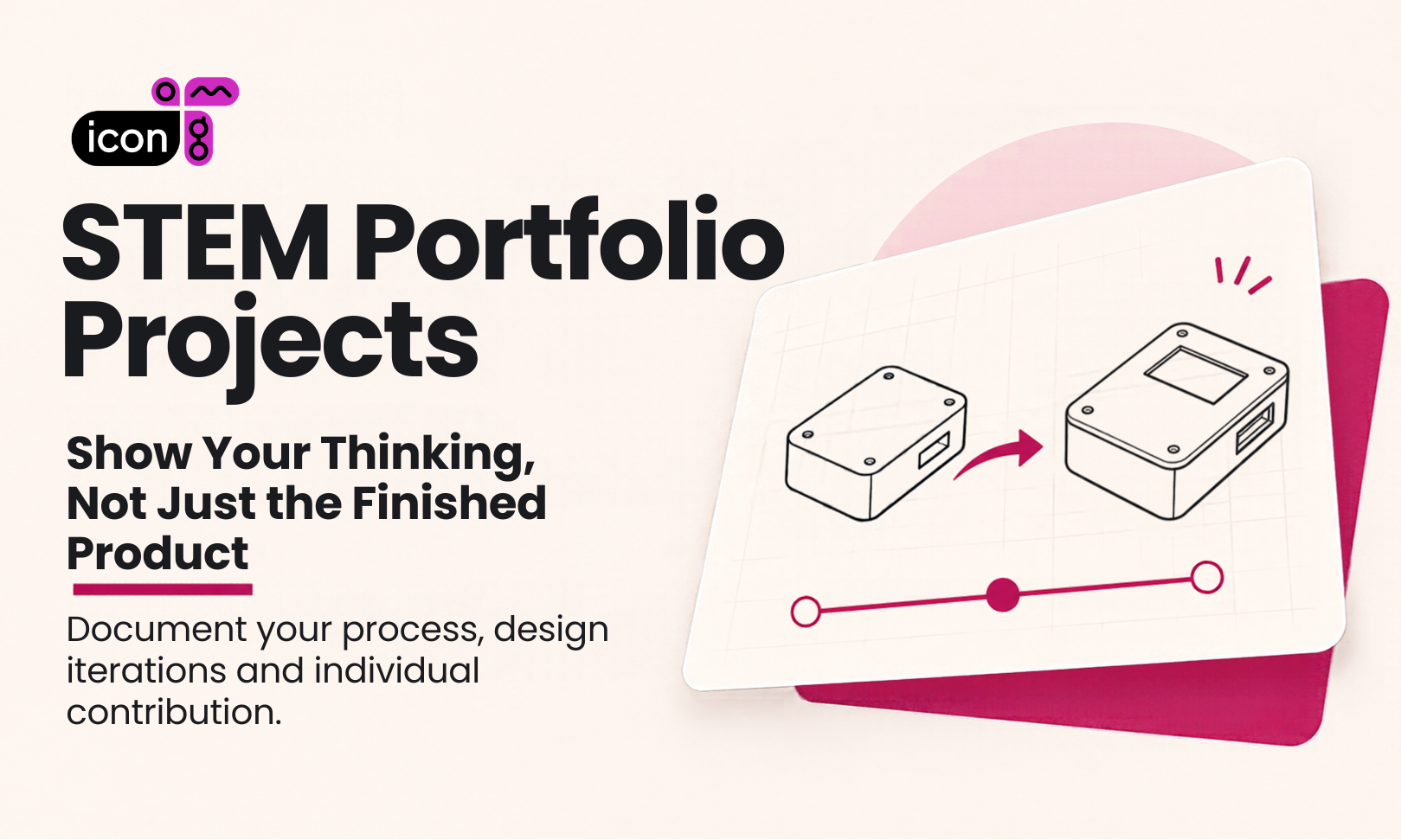
A photograph of the finished prototype or a screenshot of your code might demonstrate what you created. It does not necessarily explain the problems you encountered, the decisions you made or how your approach changed.
For undergraduate STEM applicants, documenting those decisions can help communicate the reasoning behind a project.
This guide explains how to develop meaningful STEM portfolio projects, record your progress, select useful evidence and describe your individual contribution. It also covers how to check whether universities such as MIT and Caltech accept supplementary portfolios.
The three project examples below are hypothetical and intended for learning purposes. They are not official university submissions, examples of admitted students' work or guarantees of admission.
What Makes a Useful Project Question?
A useful STEM project begins with a question you can investigate rather than a product you simply want to display.
For example, "Build an impressive engineering prototype" is too broad to guide a clear investigation.
A more focused question might be:
"How can I design a foldable phone stand that remains stable at different viewing angles?"
This gives the student a specific problem, a design constraint and something they can test.
Before starting, consider:
- Problem: What are you trying to understand, create or improve?
- Method: What can you realistically build or investigate?
- Evidence: What observations or tests could help you evaluate your approach?
- Limitations: What might your project be unable to demonstrate?
A project does not need to produce a breakthrough invention or published research.
However, it should provide enough opportunity for you to investigate a problem, make decisions and explain what you learned.
Example 1 — Engineering: Designing a Foldable Phone Stand
Project question: How can a compact phone stand remain stable while supporting different viewing angles?
A student sketches several designs and builds an initial prototype using inexpensive materials.
During testing, the stand becomes unstable at a steeper viewing angle.
The student suspects that the rear support is too narrow, so they develop a revised design and plan another test.
Useful project evidence:
- Initial and revised design sketches.
- Photographs of the prototypes.
- A simple stability-testing record.
- An explanation of the design change.
- Notes on further testing needed.
The important evidence is not just the finished stand. It is the connection between the problem observed and the decision to revise the design.
Example 2 — Computer Science: Building a Revision Mistake Tracker
Project question: Can a simple application help students organize mistakes from practice questions?
A student develops a basic program that records questions answered incorrectly and groups them by topic.
When testing the program with fictional sample entries, the student notices that duplicate records are difficult to identify.
They introduce input validation and a tagging function, then test whether the revised features behave as intended.
Useful project evidence:
- Early interface sketches.
- Selected code and version history.
- A description of the duplicate-entry problem.
- Test results for the revised functions.
- A working demonstration, where appropriate.
The student can explain why the changes were made without claiming that the application improves examination performance.
For computer science extracurricular projects, documenting the development process can be as informative as displaying a functioning program.
Example 3 — Applied Science: Investigating Temperature Differences
Project question: How do recorded temperatures compare between shaded and unshaded areas within a school environment?
With appropriate permission, a student develops a simple observational investigation.
They select measurement locations, record temperatures at planned intervals and organize their observations in a spreadsheet.
During the investigation, they recognize that changing weather conditions, wind and differences between measurement surfaces could affect the readings.
They revise their recording procedure and identify variables that remain difficult to control.
Useful project evidence:
- The original investigation question.
- The measurement procedure.
- Data tables and graphs.
- Notes explaining changes to the method.
- A discussion of uncertainty and limitations.
This example demonstrates scientific reasoning using accessible resources.
The student should not claim that shade alone caused any recorded temperature difference when other influencing factors were not controlled.
These three hypothetical projects illustrate how engineering application projects, coding activities and scientific investigations can generate meaningful evidence of a student's thinking.
They are examples of how to document learning, not projects that automatically qualify for a university's optional portfolio.
How Do You Document Iteration and Failure?
A final product rarely shows every decision involved in developing a STEM project.
To explain your process, you need evidence of what you tried, what happened and why you changed your approach.
A simple project development log can help you preserve that information.
Use a Project Documentation Template
You do not need a lengthy research report after every working session.
Instead, record the decisions and observations that explain how your project developed.
| Component | What to record |
|---|---|
| Project question | What problem are you investigating? |
| Initial approach | What did you plan to build, test or analyze? |
| Prediction | What did you expect, and why? |
| Test or investigation | What did you actually do? |
| Observation | What happened? |
| Problem or limitation | What did not work, or what remains uncertain? |
| Revision | What did you change, and why? |
| Next step | How could you evaluate the revised approach? |
| Individual contribution | Which decisions and tasks were yours? |
| Supporting evidence | Which photographs, sketches, code or records support your explanation? |
This template can be maintained in a notebook, spreadsheet or digital project log.
The aim is to document your reasoning, not to create unnecessary paperwork.
Worked Example — Recording an Engineering Revision
Return to the hypothetical foldable phone stand project.
| Stage | Example documentation |
|---|---|
| Initial design | Foldable stand with a narrow rear support |
| Test | Place a phone on the stand at different viewing angles |
| Observation | The stand becomes unstable at a steeper angle |
| Possible explanation | The rear support may be too narrow |
| Revision | Design a wider support structure |
| Next test | Repeat the stability test under similar conditions |
| Remaining limitation | Stability with different phone weights has not been evaluated |
This record shows a clear relationship between the observation and the next design decision.
It does not assume that the revised version has already solved the problem.
Turn Your Evidence Into a Portfolio Entry
Recording your work is the first step. You also need to present selected evidence in a way that another person can understand.
Here is how the hypothetical engineering project could be summarized.
Project: Foldable Phone Stand — Prototype Revision
Project description:
My first prototype became unstable at steeper viewing angles. I suspected that the rear support was too narrow, so I developed a design with a wider support structure. The accompanying sketches show the original and revised versions, while my testing notes explain the observation that prompted the change. Further testing is needed to evaluate stability with different phone weights.
Suggested supporting materials:
| Evidence | What it demonstrates |
|---|---|
| Initial sketch | Original design approach |
| First prototype photograph | How the initial design was constructed |
| Testing notes | The instability observed |
| Revised design sketch | The change made in response |
| Reflection | What still needs investigation |
This is an illustrative presentation format, not a template required by MIT, Caltech or another university.
The example works because each item has a purpose. The reader can understand the technical problem, the student's reasoning and the project's current limitations.
How Should You Explain an Unsuccessful Attempt?
An unsuccessful test can provide useful evidence when you explain what it revealed.
Compare:
Less informative:
"The first version failed, so I improved it."
More informative:
"The first prototype became unstable at steeper viewing angles. I suspected the rear support was too narrow, so I redesigned it and planned another test."
The second explanation identifies an observation, a possible cause and a response.
It does not claim that the revised design was successful before further testing.
When preparing a portfolio, choose evidence that helps tell this sequence clearly.
A few well-explained sketches, test records or code revisions can be more useful than a large collection of screenshots without context.
How Should You Show Your Own Contribution?
A team project may produce an impressive result, but university reviewers still need to understand what you contributed.
This matters for engineering teams, coding collaborations, school research groups and supervised projects.
Separate Team Outcomes From Individual Work
Imagine three students developing an environmental monitoring prototype.
One student writes the code, another assembles the device and the third designs the testing procedure.
If the third student is presenting the project, the description should focus on their responsibilities.
Less informative:
"We developed an environmental monitoring system and improved its performance."
More informative:
"I designed the testing procedure, recorded inconsistent sensor readings and worked with the team to revise the placement of the measuring device."
The second description identifies the student's role without claiming ownership of the entire project.
It also explains a specific contribution to the development process.
Explain Your Decisions, Not Just Your Tasks
A list of responsibilities tells a reader what you did.
An explanation of your decisions can show how you approached the work.
For example, a student who developed a mistake-tracking application could explain why they added input validation.
Rather than writing:
"I developed a tagging system and improved the application."
They could write:
"During testing, I noticed that duplicate entries made revision records difficult to organize. I added input validation and tested how the program handled repeated submissions."
This explanation provides evidence of technical reasoning.
It also makes the contribution easier to discuss in an application or interview.
How Should You Acknowledge Mentors and Collaborators?
Be accurate about the help you received.
If a teacher helped you develop the project question, acknowledge that guidance.
If a mentor introduced you to a programming technique, distinguish their support from the code you wrote independently.
If your project uses open-source software, explain what you adapted or developed yourself.
You do not need to claim that every idea or technical component originated with you.
Before selecting an artifact for your portfolio, ask:
What does this piece of evidence demonstrate about my contribution?
For example, a team photograph may show participation, but a labeled design sketch, version history or testing record may communicate your individual work more clearly.
Only include authentic evidence that you are permitted to share. Do not invent results, present another person's work as your own or disclose confidential research materials.
Does Your Target University Accept a Portfolio?
Not every university requires or accepts a separate STEM portfolio.
This distinction matters because developing project evidence and submitting supplementary portfolio materials are different tasks.
A project may be relevant to an activity description, essay or interview even when a university does not provide a dedicated portfolio submission route.
A STEM university application portfolio should therefore be prepared around the institution's actual instructions rather than a universal submission format.
MIT: Optional Maker and Research Portfolios
MIT allows applicants to submit optional creative portfolios through SlideRoom.
These include the Maker Portfolio and Research Supplement, which have different purposes.
According to MIT's official creative portfolio guidance, the Maker Portfolio is intended for substantial, original and technically creative projects developed through an applicant's own design and making.
MIT expects meaningful experience with the type of work being submitted and places particular emphasis on documenting the building process.
The hypothetical projects in this guide demonstrate documentation techniques. They should not be treated as examples that automatically meet MIT's Maker Portfolio standards.
Applicants considering a Maker Portfolio should understand several important requirements.
| Requirement | MIT Maker Portfolio guidance |
|---|---|
| Portfolio status | Optional |
| Media attachments | Up to 25 |
| Video duration | No more than 2 minutes in total across the portfolio |
| Projects with moving parts | Video demonstration required |
| Coding projects | Codebase and accessible working demonstration required |
| Work in progress | Permitted, but reviewers can assess only the completed work |
| Supporting explanations | Required for media attachments |
| Submission platform | SlideRoom |
For coding projects, MIT specifies that the codebase should ideally be version-controlled. The working demonstration may be provided through video, a live demonstration or an executable format, provided reviewers can access it.
MIT also explains that reviewers are more interested in the building process than the final result.
Therefore, the purpose of a portfolio should not be to fill every available attachment slot.
Applicants should select evidence that helps explain the project and follow MIT's instructions for the relevant application cycle.
MIT's Research Supplement is a separate option for significant research completed outside regular high school classes.
For a broader overview of undergraduate STEM admissions, see Icon Education's How to Get Into MIT STEM Programs.
Caltech: Optional STEM Portfolio Materials
Caltech also accepts optional supplementary materials.
Its official portfolio guidance lists several forms of STEM work that applicants may submit, including:
- Coding projects.
- Research posters.
- Photographs or videos of homemade inventions.
- Robotics projects.
- Engineering sketches and schematics.
- Personal notebooks.
- STEM presentations and explanations of technical problems.
For group projects, Caltech asks applicants to explain their individual role and contribution.
The university also emphasizes the applicant's connection to the project, including their motivation and approach.
A Caltech portfolio is optional. The university states that applicants are not disadvantaged simply because they do not submit supplementary materials.
STEM Portfolio vs Research Submission at Caltech
Caltech distinguishes between general portfolio materials and formal research submissions.
Its Research Papers and Publications route is intended for work meeting specific research criteria, including experience with a university or research-affiliated laboratory, close involvement with a senior researcher and a resulting paper or publication that is published, submitted or in preparation.
Applicants using that route must follow additional requirements, including a research description and a recommendation from the research site. A full paper or publication is strongly preferred, although other specified materials may be accepted.
By contrast, independent investigations, classroom research and other STEM projects that do not meet those criteria may be more appropriate for a general portfolio.
For example, the hypothetical school temperature investigation in this guide would not automatically qualify as a formal research submission.
Students should review Caltech's Research Papers and Publications guidance before deciding where their work belongs.
Caltech also provides a Research or Portfolio Quiz to help applicants choose the appropriate category.
After submitting the main application, students receive access to the Beaver Breakroom portal, where they can upload the supplementary materials indicated in their application.
For broader information about studying STEM at the institution, read Icon Education's How to Get Into Caltech STEM Programs.
MIT vs Caltech: What Should You Verify?
| Question | MIT | Caltech |
|---|---|---|
| Is a STEM-related supplementary portfolio compulsory? | No | No |
| Can applicants submit technical projects? | Yes, if they meet the relevant Maker Portfolio criteria | Yes, through the applicable portfolio category |
| Is the development process relevant? | Yes, explicitly emphasized | Yes, including motivation, approach and individual contribution |
| Is formal research handled separately? | Yes, through the Research Supplement | Yes, through the Research Papers and Publications route |
| Where are materials submitted? | SlideRoom | Beaver Breakroom |
| What should applicants verify? | Portfolio eligibility, documentation rules, media limits and deadlines | Submission category, supporting materials, portal instructions and deadlines |
This comparison is illustrative and not an exhaustive guide to either university's admissions requirements. Always check the instructions for your intended application cycle.
How Should You Select Your Final Portfolio Evidence?
Once you have confirmed that a university accepts supplementary materials, select the evidence that best explains your project.
Use this five-step process:
1. Choose a focused project.
Prioritize work you understand well enough to explain, including its technical challenges and limitations.
2. Identify the important decisions.
Select the observations, tests or problems that influenced the development of the project.
3. Match each decision to evidence.
Use sketches, photographs, test records, selected code or other authentic materials to support your explanation.
4. Clarify your contribution.
Make it clear which tasks, decisions and revisions were yours.
5. Follow the university's submission rules.
Check accepted formats, portfolio categories, limits, deadlines and submission platforms before preparing the final materials.
Avoid adding files simply to make your portfolio appear more extensive.
If your university does not accept supplementary portfolios, use only the application sections and formats it permits.
Final STEM Portfolio Checklist
Before presenting a STEM project in your university application, confirm:
- My project has a clear question or technical purpose.
- I can explain why I selected my approach.
- I have recorded important tests and observations.
- My evidence shows how the project developed.
- I have explained unsuccessful attempts honestly.
- My individual contribution is clearly identified.
- I can support the claims made in my descriptions.
- I have acknowledged relevant mentors, collaborators and existing tools.
- I have checked whether my target university accepts supplementary portfolios.
- My submission follows the institution's current requirements.
Final Takeaway
Strong STEM portfolio projects are not defined solely by how impressive the finished product looks.
They can also demonstrate how a student investigates a problem, evaluates evidence, makes decisions and responds to unexpected results.
For undergraduate STEM applicants, a practical approach is to:
Choose a focused question → document the process → explain your contribution → select meaningful evidence → verify university requirements
Remember that an interesting learning project does not automatically qualify for every university's supplementary portfolio.
The aim is to present your work accurately, in the format your target institution accepts, and with enough context for a reviewer to understand the thinking behind it.
Develop a focused plan for demonstrating your STEM interests.