
A useful LNAT essay example should show more than a finished response.
It should show how the argument was built, where it could be improved and why certain choices are more effective than others.
In LNAT Section B, candidates currently have 40 minutes to answer one of three essay questions. Official LNAT guidance recommends a maximum of 750 words and suggests that around 500–600 words is ideal.
Within that time, you need to interpret the question, choose a position, develop your reasoning, consider an alternative view and review your response.
There is no single essay formula that every candidate must follow. The worked example below demonstrates one possible approach to LNAT essay structure. It is not an official LNAT model answer, a universal marking scheme or a guaranteed high-scoring response.
How Should You Choose and Interpret a Prompt?
When you see three essay questions, do not automatically choose the topic you know the most facts about.
LNAT Section B does not require specialist legal knowledge.
A more useful question is:
Which prompt gives me enough ideas to develop and test a clear argument?
Before choosing, look for:
- the central disagreement;
- key terms that may need interpretation;
- at least two defensible perspectives;
- assumptions you can question;
- a position you could develop within the available time.
The aim is not to find the question with the most facts attached to it.
It is to find a question you can reason about clearly.
Original Practice Prompt
The following prompt was created for this article. It is not an official LNAT question, recalled test material or a prediction of a future LNAT essay topic.
Should social media platforms be required to verify the identity of every user?
At first glance, this appears to ask whether identity verification is good or bad.
But several tensions sit underneath the question:
- accountability vs privacy;
- safety vs anonymity;
- preventing abuse vs protecting vulnerable users;
- universal rules vs targeted intervention.
The word “every” is especially important.
The question is not asking whether verification can sometimes be useful. It asks whether the same requirement should apply to all users.
That distinction gives you something precise to argue about.
A Quick Planning Map
Arguments for universal verification
- may discourage harassment or impersonation;
- could increase accountability;
- may make enforcement easier.
Arguments against universal verification
- anonymity can protect vulnerable users;
- verification does not necessarily prevent harmful behavior;
- identity collection may create privacy concerns;
- different users and activities create different levels of risk.
Useful assumption to test
Does knowing a user’s identity necessarily make that person behave more responsibly?
Possible position
Social media platforms should not be required to verify every user because anonymity can serve legitimate purposes and verification alone cannot eliminate harmful behavior. However, stronger verification may be justified in specific high-risk contexts.
This gives the essay a clear position while leaving room for qualification.
What Makes a Clear Argument?
A clear argument is more than a strong opinion.
The reader should be able to follow:
what you believe → why you believe it → what supports your reasoning → where the limits of your position are
A practical outline for the prompt above might look like this.
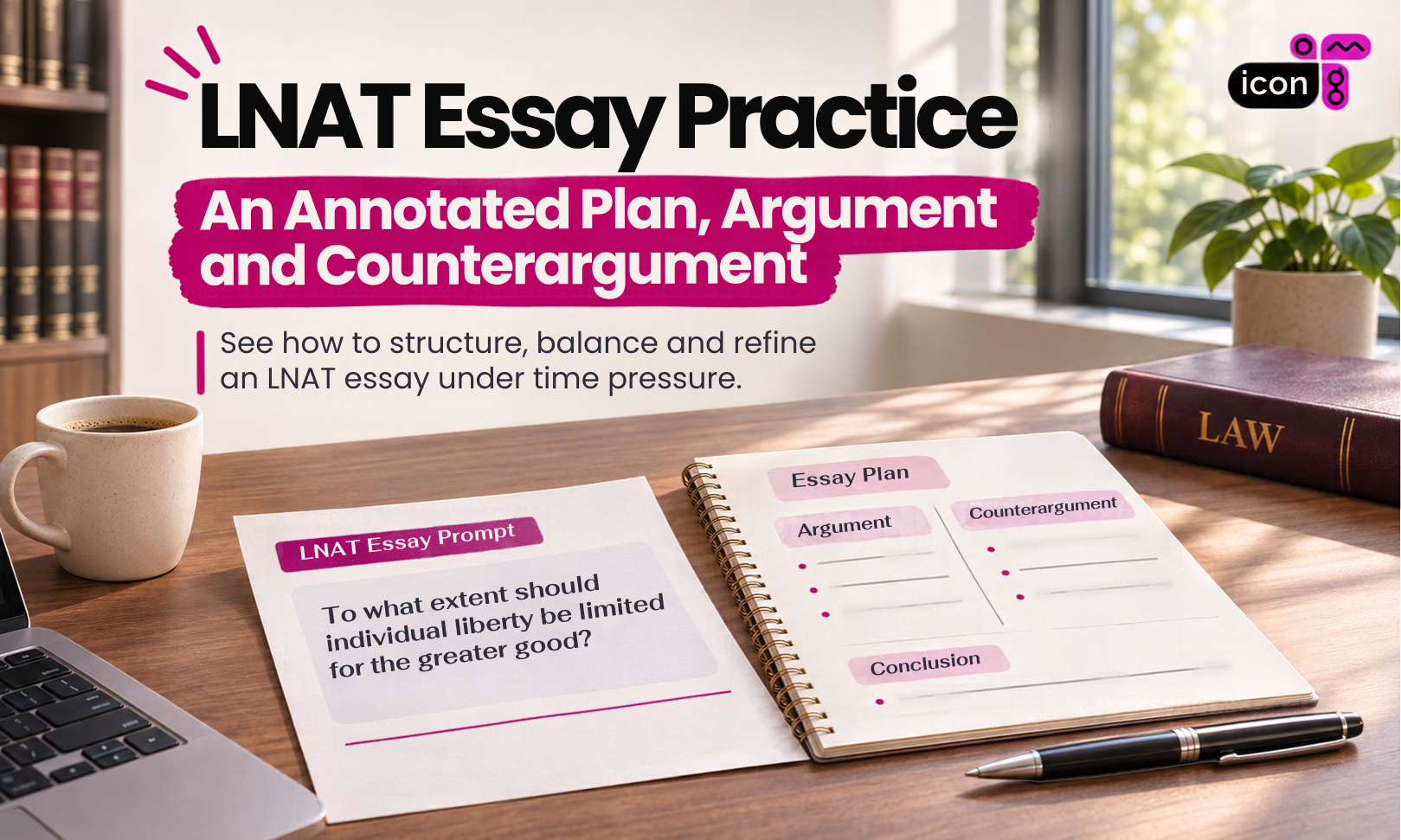
Annotated Essay Plan
| Section | Purpose | Planned reasoning |
|---|---|---|
| Introduction | Define the disagreement and establish a position | Accountability matters, but universal identity verification is too broad. |
| Body 1 | Explain the strongest reason against a universal rule | Anonymity can enable legitimate participation for vulnerable users. |
| Body 2 | Test an assumption behind verification | Knowing someone’s identity does not necessarily prevent harmful behavior. |
| Body 3 | Address the strongest counterargument | Verification can improve accountability in some situations. |
| Body 4 | Refine the position | A targeted requirement is more defensible than a universal one. |
| Conclusion | Return to the governing principle | Rules should balance accountability with legitimate reasons for anonymity. |
Notice that each paragraph has a different job.
The structure is not simply:
introduction → example 1 → example 2 → example 3 → conclusion
Instead, the reasoning develops from one stage to another.
Annotated Original Response
The response below was created specifically for this article as an instructional example. It is not an official LNAT model answer and should not be treated as a guaranteed high-scoring response.
Social media allows people to communicate with audiences that would once have been impossible to reach. That freedom also creates opportunities for harassment, impersonation and deliberate misinformation. Requiring every user to verify their identity may therefore appear to offer a simple route to greater accountability. However, universal verification would treat anonymity itself as the problem when the more important issue is how people behave. Platforms should not be required to identify every user, although stronger verification may be justified where particular activities create greater risks.
Annotation — Thesis and scope:
The paragraph identifies the tension and gives a qualified position rather than an absolute one. Importantly, it responds to the word “every” instead of turning the essay into a general discussion of online safety.
Anonymity can serve legitimate purposes. A person discussing a sensitive health condition, reporting workplace misconduct or participating in a community where their identity could expose them to danger may have good reasons not to connect their public comments to their legal name. Removing that option could reduce harmful behavior, but it could also discourage people whose participation depends on privacy. A policy designed to make online spaces safer should therefore consider whom it might unintentionally silence.
Annotation — Development:
The paragraph gives anonymity a legitimate function rather than treating it as automatically positive or negative. The examples support the claim instead of appearing as unrelated evidence.
Possible weakness:
The paragraph could distinguish more clearly between public anonymity and a platform privately verifying someone’s identity. That distinction might complicate the argument and make it stronger.
Universal verification also assumes that identifying users will substantially improve behavior. That assumption is questionable. People regularly behave irresponsibly even when their identities are already known to employers, schools or wider communities. Verification may make it easier to identify someone after misconduct occurs, but it does not automatically prevent the misconduct itself. Platforms may therefore achieve more by improving moderation, reporting systems and enforcement than by collecting the identity of every user.
Annotation — Testing an assumption:
This paragraph moves beyond simply listing disadvantages. It questions the assumption that identity verification necessarily produces better behavior.
Possible weakness:
The final sentence introduces moderation and enforcement but does not explore them in detail. Under time pressure, that is acceptable, but the writer should avoid opening too many new lines of argument.
The strongest argument for verification is accountability. Anonymous accounts can make impersonation, coordinated abuse or repeated rule-breaking harder to investigate. In situations where an account can reach a very large audience, purchase political advertising or conduct financial transactions, requiring additional verification may be reasonable. Yet this argument supports targeted verification more convincingly than a universal rule. The level of identification required should reflect the level of risk created by the activity.
Annotation — Counterargument and concession:
The essay takes the opposing view seriously rather than dismissing it. It concedes that verification may be useful and then uses that concession to refine the original position.
Possible weakness:
“Level of risk” could be defined more precisely. The examples suggest a principle, but the essay could explain more explicitly why some activities justify stronger identification requirements.
The choice is therefore not between complete anonymity and complete identification. Social media platforms can preserve ordinary users’ ability to participate privately while imposing stronger requirements where there is a clear reason for greater accountability. Universal verification offers the attraction of a simple rule, but simplicity is not always fairness. A proportionate approach is more likely to protect both online safety and the legitimate reasons people may have for remaining anonymous.
Annotation — Conclusion:
The conclusion returns to the central distinction between universal and targeted verification and develops the thesis rather than merely repeating the introduction.
It could be shortened slightly under test conditions, but the reasoning remains consistent with the position established at the beginning.
What Can You Learn From the Response?
The response works because it:
- answers the exact question;
- uses a qualified position;
- gives each paragraph a distinct reasoning function;
- explains why examples matter;
- engages with a serious counterargument;
- refines the thesis rather than repeating it.
It is not perfect.
That is important.
A useful LNAT essay example should give you something to analyze and improve, not something to memorize.
How Should You Handle a Counterargument?
LNAT preparation guidance encourages candidates to think about how arguments can be challenged and how counterarguments might be framed.
A counterargument should therefore do more than satisfy an essay template.
It should test whether your position still works when confronted with the strongest reasonable objection.
In this example, the counterargument is:
Identity verification can improve accountability and make certain forms of misuse easier to investigate.
A weak response would dismiss it immediately:
Verification cannot solve every problem, so it is unnecessary.
That does not seriously engage with the opposing position.
A stronger approach is:
opposing argument → reasonable concession → limitation → refined position
For example:
Verification can improve accountability where misuse carries significant consequences. However, that benefit does not establish that every user creates the same level of risk. A targeted requirement may therefore preserve the strongest advantage of verification without unnecessarily removing anonymity from ordinary users.
The counterargument improves the thesis.
The writer is no longer simply saying:
“Verification is bad.”
The position becomes:
Verification may be justified when the risk is high, but that does not justify a universal requirement.
When practicing, ask:
- What is the strongest objection to my position?
- Which part of it is reasonable?
- Does it defeat my argument?
- Or does it show that my original claim needs to become narrower?
A good counterargument often makes your final position more precise.
How Can You Edit Under Time Pressure?
With 40 minutes available for Section B, editing cannot mean rewriting the entire essay.
Your final review should focus on the changes most likely to improve clarity and relevance.
1. Check the Exact Question
Ask:
Have I answered the wording of the prompt?
For the worked example, the key word is every.
If the response became a general essay about whether social media is harmful, polished writing would not solve the relevance problem.
2. Check Your Position
Try to state your argument in one sentence.
If you cannot, your position may be too broad or inconsistent.
Compare your introduction and conclusion.
They should reflect the same central argument.
3. Remove Repetition
Watch for two sentences doing the same job.
For example:
Universal verification is too broad because it applies to everyone. A universal rule would affect all users regardless of circumstance.
One sentence is enough.
4. Check the Reasoning Between Paragraphs
Ask:
- What new idea does this paragraph add?
- Why does it come after the previous paragraph?
- Does the example actually support the claim?
- Have I explained the connection?
A paragraph should advance the argument rather than merely add another example.
5. Simplify Unclear Sentences
Do not use complicated vocabulary simply to make the essay sound more academic.
If a shorter sentence communicates the reasoning more clearly, use it.
Clear reasoning is more valuable than unnecessarily elaborate language.
A Practical Self-Review Checklist
This checklist is an instructional practice tool. It is not an official LNAT marking scheme.
| Area | Question to ask |
|---|---|
| Prompt | Have I answered the exact question rather than a related topic? |
| Position | Is my central argument clear and appropriately qualified? |
| Reasoning | Does each paragraph explain why my claim is convincing? |
| Examples | Does each example support a specific point? |
| Counterargument | Have I addressed a serious alternative view? |
| Structure | Does each paragraph add something new and relevant? |
| Conclusion | Does it follow logically from the argument? |
| Clarity | Can anything be made shorter or more precise? |
Do not turn the checklist into a rigid score.
Instead, use it across several LNAT essay practice sessions to identify recurring weaknesses.
You may discover that you regularly:
- choose positions that are too absolute;
- spend too long introducing the topic;
- use examples without explaining their relevance;
- dismiss opposing arguments too quickly;
- repeat ideas in the conclusion;
- leave too little time to review.
Those patterns tell you more than simply labeling one essay “good” or “bad.”
For the wider preparation process, including Section A, timing and official resources, see Icon Education’s How to Prepare for the LNAT.
Final Takeaway
A useful LNAT essay structure should make your reasoning clearer, not force every question into the same formula.
Start by interpreting the exact question.
Then work through:
interpret the prompt → choose a defensible position → plan the reasoning → test it with a counterargument → edit for clarity and relevance
When reviewing an LNAT essay example, do not ask only:
“Is this a good essay?”
Ask:
Why does this argument work, and where could it become stronger?
That question is more useful because it turns a sample into a tool for improving your own reasoning.
Get feedback on the clarity and reasoning of your LNAT writing.