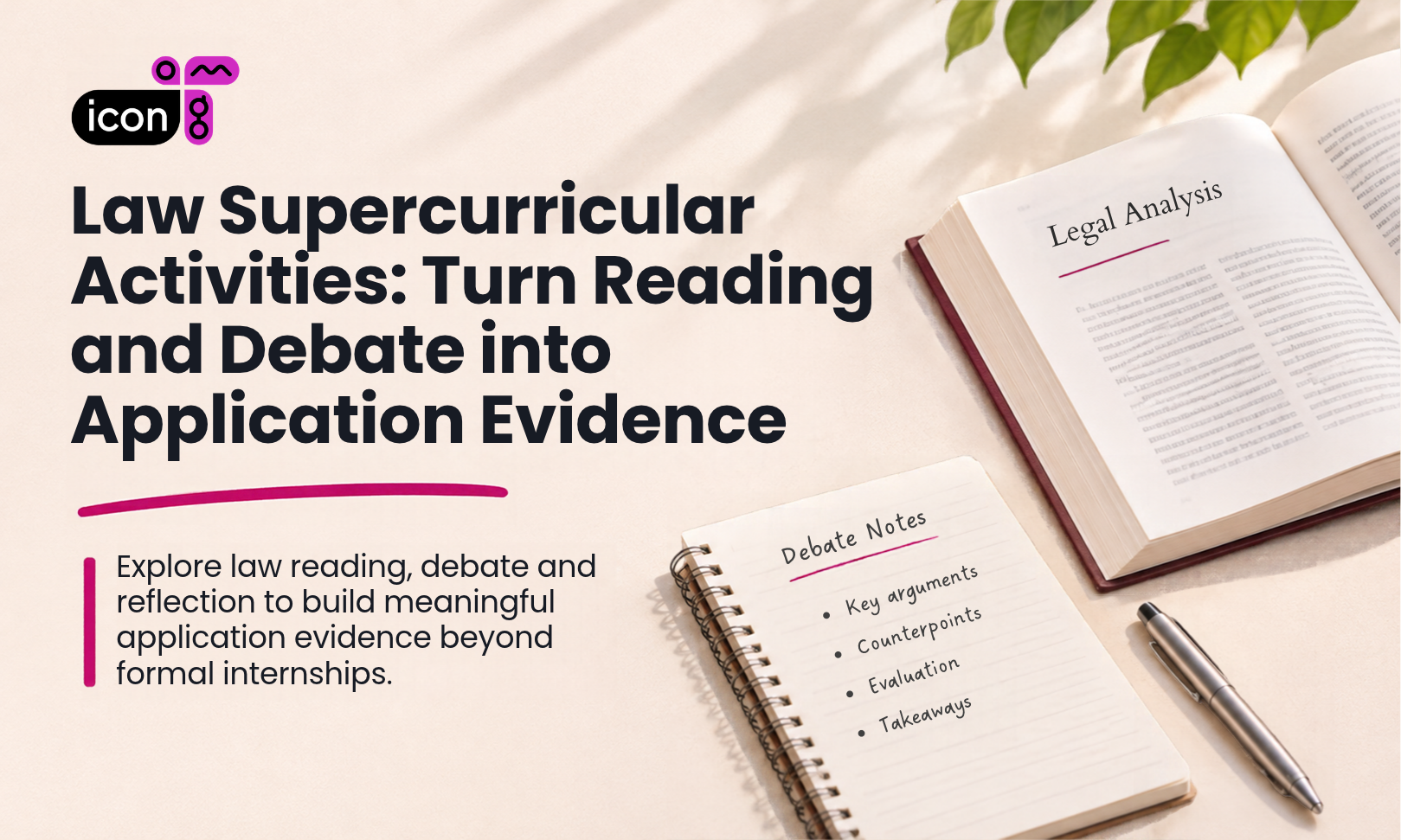

Reading a legal article, watching a university lecture or joining a debate can help you explore an interest in law. But completing these activities does not automatically demonstrate meaningful academic engagement.
What matters is how you respond to the ideas you encounter.
Did a case challenge your assumptions? Could you explain an argument you disagreed with? Did a discussion lead you to investigate a new legal question?
For students exploring law supercurricular activities, these questions are more useful than simply collecting impressive experiences.
You do not need a formal legal internship to begin exploring law. Universities such as Oxford and Cambridge emphasize academic curiosity, reasoning and critical engagement rather than prior legal knowledge or a particular list of activities.
This guide shows how reading, discussion and reflection can help you develop your understanding of law. It includes an original reading-log example, accessible resources and practical exercises.
The examples are instructional, not official university assessment questions or guarantees of admissions outcomes.
What Is Academic Exploration Beyond School?
Supercurricular activities extend your academic interests beyond the classroom.
For prospective law students, that could mean examining a court judgment, comparing arguments about legal principles or exploring how law interacts with society.
The goal is to develop the habits involved in studying law:
- identifying the central issue;
- distinguishing claims from evidence;
- evaluating competing arguments;
- questioning assumptions;
- reconsidering an initial position.
Oxford describes supercurricular learning through three stages: Explore, Engage and Reflect. Cambridge similarly emphasizes how independent academic exploration encourages students to think critically and develop their own interests.
A Four-Part Law Exploration Menu
You can begin with four accessible activities.
|
Activity |
What to do |
Useful outcome |
|
1. Read |
Examine a judgment summary or introductory legal article |
Identify the issue, reasoning and questions raised |
|
2. Watch or listen |
Follow a university law lecture or podcast |
Compare an expert's argument with your initial view |
|
3. Debate |
Discuss a legal dilemma with classmates or a study partner |
Develop arguments, counterarguments and a revised position |
|
4. Investigate |
Explore one legal question through several reliable sources |
Compare interpretations and identify unresolved questions |
These are starting points, not a compulsory sequence.
You might begin with a podcast, encounter a legal issue you disagree with and then investigate a related judgment.
The important progression is:
Explore → Question → Evaluate → Reflect
Where Can You Find Accessible Law Resources?
For students exploring law extracurricular activities in Singapore, meaningful academic exploration does not have to depend on securing a placement at a law firm.
Several resources are publicly available.
Cambridge Law
The University of Cambridge offers Exploring Law: Studying Law at University, a free online course primarily designed for students aged 16–18.
It introduces legal concepts, academic skills and aspects of studying law at university.
The course runs on scheduled dates, with free access subject to registration and an access period. Check the official page for current enrollment information.
Oxford Law
The Oxford Faculty of Law podcast collection provides lectures and discussions on legal topics, including public law, human rights and international law.
Choose one accessible discussion and record the argument you found most interesting or difficult to accept.
Singapore Courts Judgments
The Singapore Courts Judgments database allows users to search publicly available judgments.
Start with one manageable case. Identify the legal issue, the court's reasoning and the conclusion.
UK Supreme Court
The UK Supreme Court case collection provides published judgments and case information, including press summaries for some decisions.
A press summary can be a useful starting point before reading more of the judgment.
Are Legal Internships Necessary?
Not necessarily.
Cambridge explicitly states that legal work experience is not required for undergraduate Law applicants. It recognizes that access to professional opportunities can depend on personal connections.
An internship may help you explore the profession, but it is not a compulsory step or an automatic admissions advantage.
Independent reading, discussion and research can also develop your understanding of law.
Do UK and US Applications Expect the Same Activities?
No. The academic pathways and admissions contexts differ.
|
UK undergraduate Law |
US undergraduate admissions |
|
Students can apply directly to undergraduate Law degrees. |
Students generally complete an undergraduate degree before later pursuing professional legal education through a JD. |
|
Exploring legal questions can help students understand the subject they intend to study. |
Law-related activities may form part of a broader set of academic interests. |
|
Universities such as Oxford assess reasoning, communication and academic potential. |
Undergraduate admissions expectations vary by institution and may consider a broader range of experiences. |
The American Bar Association does not recommend one specific undergraduate major as preparation for law school.
This means there is no universal formula for building a law application portfolio.
Admissions expectations vary by university. Check each target institution's selection criteria rather than assuming every application requires identical activities.
For broader guidance on the UK pathway, see Icon Education's How to Get into Oxbridge Law.
How Can You Engage Critically With a Case or Article?
Reading is a useful starting point, but summarizing a source is only the first step.
A stronger approach is to ask:
- What legal question is being considered?
- What reasoning supports the conclusion?
- What counterargument deserves consideration?
- What remains uncertain?
- Did the source change my initial view?
Worked Example — Reading a Supreme Court Case
Consider the UK Supreme Court decision in R (Miller) v The Prime Minister [2019] UKSC 41.
The case examined the lawfulness of the Prime Minister's advice to prorogue Parliament.
Prorogation means formally bringing a parliamentary session to an end. It differs from an ordinary parliamentary recess.
The central questions included whether the courts could review the advice and whether it exceeded the legal limits of the relevant executive power.
The Supreme Court found that, in the circumstances of this case, the prorogation had a sufficiently serious effect on Parliament's constitutional functions without reasonable justification. The Prime Minister's advice was therefore unlawful.
This does not mean every prorogation is unlawful. The judgment examined the legal limits of the power and the seriousness of its effects in the particular circumstances.
Students can consult the official UK Supreme Court case page, which provides the judgment and press summary.
Important: This is an example from UK constitutional law. It should not be treated as a statement of Singapore law.
Original Reading-Log Example
The following log is a fictional student's response to the real judgment. It is not an official interpretation supplied by the Court.
|
Reading-log prompt |
Student's notes |
|
Source |
R (Miller) v The Prime Minister [2019] UKSC 41 |
|
Main legal question |
Can courts determine whether advice to prorogue Parliament falls within the legal limits of executive power? |
|
My initial view |
I initially thought courts should generally avoid disputes involving political decisions. |
|
Reasoning I noticed |
The Court distinguished the political context from the legal question of whether the power had exceeded constitutional limits. |
|
Counterargument to consider |
Governments need discretion to manage parliamentary business. How should that discretion be balanced against constitutional accountability? |
|
What changed my thinking |
I began to understand that reviewing the legality of executive action is different from deciding which political outcome is preferable. |
|
Question to explore next |
How do courts determine whether an interference with constitutional functions has a reasonable justification? |
The valuable part of this exercise is not whether the student agrees with the Court.
It is the movement from a broad opinion to a more precise legal question.
Move Beyond “I Agree” or “I Disagree”
Instead of writing:
I agree with the Court because its decision was fair.
Ask:
Which constitutional principles informed the decision, and how did the Court apply them?
Instead of:
Courts should never interfere in political decisions.
Ask:
When does a dispute involving politics also raise a legal question that courts can examine?
These questions encourage closer analysis.
They also help you distinguish the Court's actual reasoning from your personal interpretation.
How Can Debate Develop Reasoning?
Debate can help law applicants practice constructing arguments, identifying assumptions and responding to opposing views.
The aim is not simply to win.
It is to understand why an argument is persuasive, where it is limited and how it responds to criticism.
You can develop these skills through a school debate club, a discussion with a study partner or an independent written exercise.
A Legal Reasoning Exercise
Consider this original discussion prompt:
What legal limits should apply when an executive advises that a parliamentary session be brought to an end?
This is an instructional discussion prompt inspired by the constitutional issues in Miller, not an official university interview question.
Before examining how the Supreme Court approached the issue, consider two competing concerns.
Concern A — Executive discretion
Governments need some flexibility to manage parliamentary business. Legal oversight should recognize the responsibilities and judgment involved in executive decision-making.
Concern B — Constitutional accountability
Executive discretion may have legal limits. Judicial review can help ensure that exercising power does not improperly prevent other constitutional institutions from performing their functions.
These concerns are not presented as alternative statements of current UK law. They are starting points for exploring the reasoning behind legal limits.
The next task is to examine how the actual judgment addresses them.
Use a Four-Step Debate Review
1. State your initial position.
What do you think, and which principle supports your view?
2. Identify the strongest counterargument.
What is the most serious challenge to your reasoning?
3. Test your assumptions.
Are you assuming that all executive decisions are beyond judicial review, or that every political disagreement should be settled in court?
4. Refine your conclusion.
Can you describe a more precise position after considering both concerns and the Court's reasoning?
For example, a student might move from:
Courts should never interfere in political decisions.
to:
Courts should distinguish political choices from questions about the legal limits of executive authority. Judicial review may be appropriate where the lawfulness of an exercise of power is in question.
The revised position is more carefully qualified.
This is the kind of intellectual development that debate can encourage.
What Should You Record After a Debate?
Write down:
- your initial argument;
- the strongest opposing argument;
- the assumption that was challenged;
- how your conclusion changed.
An informal discussion can be useful when it involves careful reasoning.
For guidance on responding to legal analysis questions in interviews, see Icon Education's Acing Your Law School Interview.
How Should You Record What Changed Your Thinking?
After several weeks, you may remember which book you read or which debate you attended but struggle to explain what you learned.
A short reflection log helps preserve the reasoning behind each experience.
A Five-Minute Reflection Framework
After an activity, answer four questions.
1. What did I explore?
Identify the source or activity.
2. What did I initially think?
Record your starting view.
3. What challenged that view?
Identify a specific argument, distinction or piece of evidence.
4. What would I investigate next?
Turn your reflection into a follow-up academic question.
Example Reflection
After examining the Miller judgment, a fictional student might write:
I initially assumed that disputes involving government decisions were primarily political matters. The judgment challenged that assumption by distinguishing political disagreement from questions about the legal limits of executive power. I became interested in how courts determine when an exercise of power interferes with constitutional functions. I would now like to explore how different legal systems approach judicial review and executive accountability.
This reflection does more than announce an interest in constitutional law.
It identifies a change in thinking and a direction for further exploration.
The student would still need to research other legal systems before making comparisons or claims about their laws.
Build Depth Rather Than Collect Activities
A student could explore one topic through a simple sequence:
Week 1: Read an accessible judgment summary and identify the legal issue.
Week 2: Listen to a related university lecture or podcast.
Week 3: Discuss a question arising from the sources with a classmate.
Week 4: Revisit the original notes and record how the student's reasoning has developed.
This is an illustrative learning sequence, not a required admissions timetable.
The goal is to connect activities around a genuine academic interest.
Academic Exploration Checklist
Before moving to another resource, ask:
- Can I explain the main legal question?
- Can I distinguish the source's reasoning from my own opinion?
- Have I considered a reasonable counterargument?
- Can I explain whether my view changed?
- Have I identified a question worth investigating further?
- Can I describe the experience accurately without exaggerating what I did?
If you can answer these questions, the activity has produced something useful: a clearer understanding of the subject and your own thinking.
Final Takeaway
Meaningful law supercurricular activities do not have to begin with formal internships, expensive summer programs or an extensive reading list.
They can begin with one accessible legal question.
Use a simple progression:
Read or listen → identify the issue → evaluate competing arguments → reflect → investigate further
For law applicants, meaningful academic exploration is not about completing the largest number of activities.
It is about developing the ability to question ideas, examine evidence and explain how your thinking has evolved.
Choose resources you can engage with seriously, consider views that challenge your assumptions and keep a record of the questions that genuinely interest you.
Plan meaningful academic exploration for your law applications.