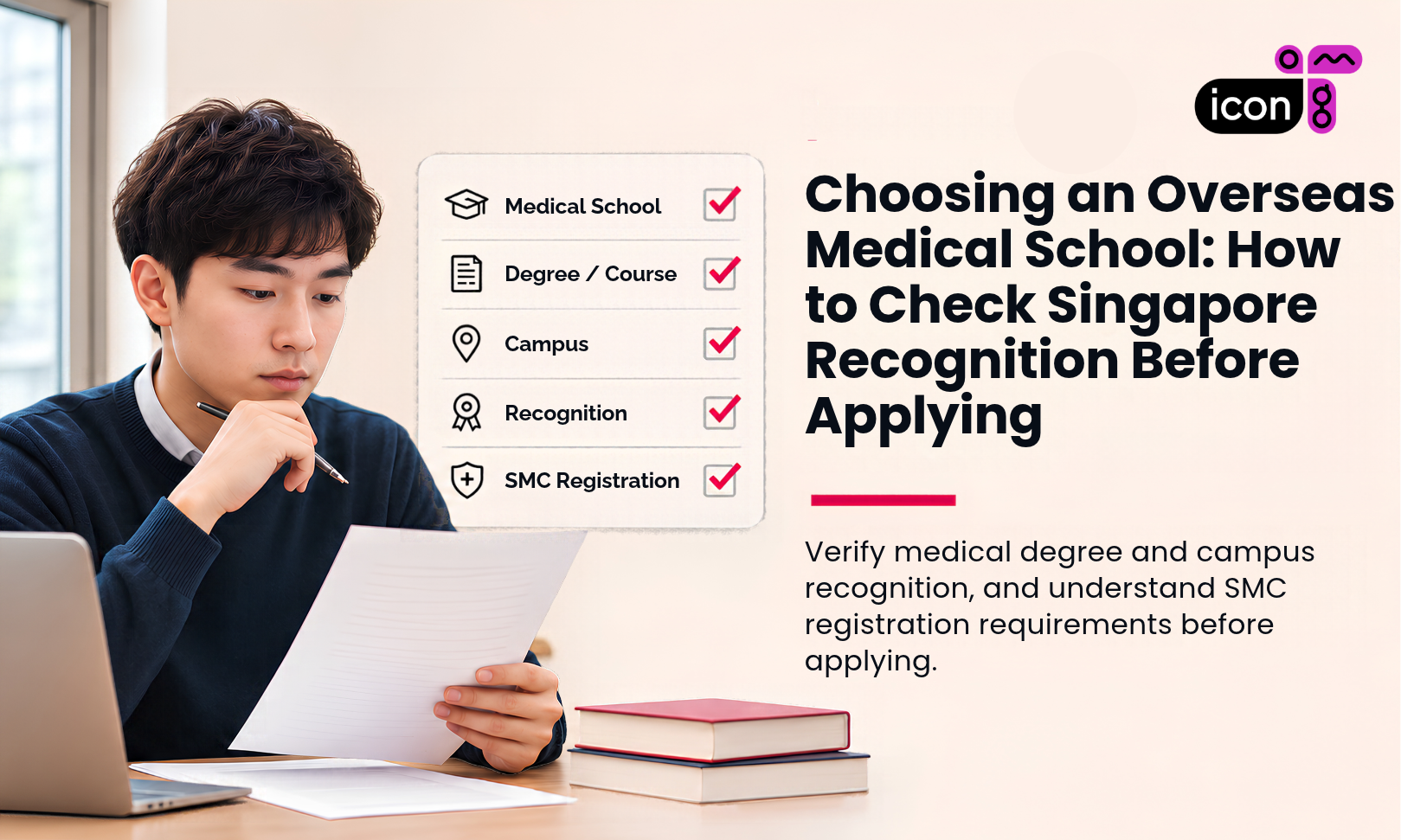

An overseas medical school may suit your grades, interests and preferred learning environment. If you plan to return to Singapore after graduation, you also need to check whether the qualification and training route can support an application for medical registration.
When comparing medical schools recognized in Singapore, look beyond the university’s name. For the basic medical qualification route, the listed institution and the corresponding award must be checked together. Attending a listed university does not, by itself, establish that your particular qualification meets the requirement.
A useful shortlist records what you have verified, which conditions apply and what still needs an official answer.
Official guidance checked on November 27, 2026. Recheck the relevant sources before making a commitment.
Where do you check the current official list?
Start at the Singapore Medical Council website. Its section on recognized medical qualifications links to the Second Schedule of the Medical Registration Act 1997 and the accompanying Important Notes. At the time of checking, the linked notes took effect on September 2, 2026. Read these documents together.
Use the following process for each course you are considering.
1. Match the institution and qualification
Open the current Second Schedule and locate the relevant country or region. Check the named university or medical school, including the faculty where specified, and the qualification shown alongside it. The list identifies both the institution granting the award and the qualification itself.
If the advertised degree title differs from the listed qualification, record the difference. The same applies if a university or faculty has changed its name. A similar name is a reason to investigate further.
2. Read the conditions attached to the list
Open SMC’s current Important Notes. These address matters such as twinning arrangements, national licensing examinations and restrictions affecting particular qualifications or programs.
Check which conditions apply to your proposed course. Finding the university’s name is the beginning of the verification process.
3. Compare the listing with your actual course
Use the university’s official course page for your intended intake, followed by your offer documents when available. Identify the final medical qualification, course code, entry route, campus and any partner institutions involved.
If the course information does not clearly match the official guidance, ask the university to confirm the program details. Direct questions about SMC recognition or registration to SMC.
This gives you a practical way to check medical degree recognition while building your shortlist, before you commit to an application or offer.
Why do degree, campus and qualification details matter?
The course you enter determines what you study, where you train and which qualification you receive. These details also matter during registration: SMC’s qualification-verification process asks the awarding institution to confirm information including the qualification title, program entry and graduation dates, and the campus where relevant.
Check the campus and delivery arrangements
SMC’s published off-site campus FAQ states that campuses off-site from a recognized main campus are not recognized. Check the exact campus and training arrangements for your proposed course. If a branch, transfer or partner arrangement is unclear, seek written clarification from SMC before committing.
Twinning programs, where study is divided between partner institutions, require particular attention. SMC’s current notes generally require applicants through these arrangements to complete all clinical training and final examinations, and receive their final qualification, at the listed medical school. Its conditional-registration guidance also specifies that the clinical training and examinations must take place in that school’s listed country.
Do not assume that a finding about one course applies to every program carrying the same university name.
A worked example: checking Monash’s Australian direct-entry course
Consider a Singapore student evaluating Monash University’s Australian direct-entry medical course for the 2027 intake. The applicant is hypothetical; the program details below come from official sources.
The student begins by comparing the SMC listing with the university’s course information.
| Item to check | Information identified |
|---|---|
| Country in the Second Schedule | Australia |
| Listed institution | Monash University, Faculty of Medicine, Nursing and Health Sciences |
| Qualifications in that entry | MB BS, MD |
| Current university course title | Bachelor of Medical Science and Doctor of Medicine |
| Course code and entry route | M6011; direct entry from high school |
| Advertised location and duration | Clayton; five years full time |
The institution and listed qualifications come from the Second Schedule. Monash’s official direct-entry course page provides the current course title, entry route, location and duration.
This comparison identifies Monash’s listed Australian institution and MD award alongside the published details of the Clayton course. The student must still apply SMC’s conditions to the actual study route, particularly if any campus, transfer or delivery arrangements differ.
The course page also explains how training is organized: the first two years are campus-based, while the final three are hospital- and community-based. Recording “Clayton” therefore does not mean assuming that every year of training takes place physically on the campus.
The useful outcome is a documented comparison of the institution, award and specific program. It is not an individual registration decision.
What is the difference between recognition and registration?
Recognition concerns the qualification. Registration concerns whether an individual meets the requirements for a particular registration category.
SMC assesses applications individually. Meeting the published criteria does not guarantee approval, and a recognized qualification does not guarantee a training position or employment offer.
Three registration categories are useful to understand when planning an overseas medical degree:
| Registration category | What it means for your planning |
|---|---|
| Provisional registration | Eligible graduates may apply to undertake 12 months of Postgraduate Year 1, or PGY1, training in approved Singapore hospitals. Applications must be submitted through a local employer whose hospitals are accredited for PGY1 training. |
| Conditional registration | This permits supervised practice in an SMC-approved healthcare institution. Requirements include an appropriate qualification, employment, completed housemanship or an equivalent internship, and other prevailing criteria. |
| Full registration | This permits independent practice. Further requirements apply, including the relevant experience and satisfactory assessments. |
Provisional, conditional and full registration have separate eligibility requirements. A recognized qualification does not automatically move a graduate through these categories.
Use SMC’s registration guidance to investigate the category relevant to your training stage. Doctors must hold both SMC registration and a valid Practising Certificate before practicing medicine in Singapore.
Check requirements beyond the degree
National licensing examinations can affect your plans. If the country in which you obtain your basic medical degree requires such examinations for its own medical graduates, SMC requires the corresponding conditions to be met for registration in Singapore. Planning to return immediately does not, by itself, remove that requirement.
Investigate the professional steps after graduation alongside the degree. Find out which examinations, internship or training applications, and employment processes would be relevant to your intended route.
A university admission offer and a future application to practice medicine are separate decisions. Your preparation should account for both.
What if the basic medical qualification is not listed?
Some applicants may be considered through a postgraduate medical qualification recognized by SMC, subject to the relevant conditions. The conditional-registration requirements also specify that the basic medical degree must come from an accredited medical school. This does not make every postgraduate course a route to registration.
When choosing your first medical degree, avoid planning on the assumption that a later qualification will resolve a recognition issue. Clarify the implications with SMC before treating that course as a suitable option for your intended return to Singapore.
What should you verify before accepting an offer?
Before accepting an offer or paying a deposit, bring your findings into one course-specific record. This helps you identify unanswered questions while you still have time to act on them.
Your pre-acceptance verification checklist
| Check | What to record |
|---|---|
| Exact qualification | The full final medical award, its abbreviation and the institution granting it. |
| Specific program | The course code, entry route, intended intake and expected graduation year. |
| Location and delivery | The campus and country, clinical-training arrangements, and any transfers or partner institutions involved. |
| Current official match | The relevant Second Schedule entry, applicable SMC conditions and the date you checked them. |
| Unresolved differences | Any mismatch in names, qualifications or delivery arrangements, together with the written clarification received. |
| Steps after graduation | The registration category you need to investigate, applicable licensing examinations, and relevant training or employment applications. |
| Offer commitments | Acceptance and deposit deadlines, refund terms, and conditions attached to your place. |
| Future checks | When you will review the guidance again, particularly if the course or your intended route changes. |
Ask a specific question when something does not match
The university can confirm facts about its course: the final award, awarding institution, study locations and clinical-training arrangements. If an admissions representative describes a pathway verbally, ask for the relevant official documentation.
SMC is the appropriate source for clarification about its recognition and registration requirements. Explain the particular difference you have identified and include the official course information.
You can adapt this enquiry template by replacing the bracketed fields:
I plan to begin [course title and code], leading to [full medical qualification], at [awarding university or faculty], [campus and country], in [entry year].
My proposed route includes [details of any partner, transfer or twinning arrangement, or “no such arrangement”].
I found [the relevant SMC listing or note], but I am unsure about [the specific difference in the qualification or training arrangement].
Does this arrangement meet the current recognition conditions for this qualification? The official course details are available here: [link].
A focused enquiry gives SMC the information needed to address your uncertainty. Use it when the published information does not clearly resolve your proposed route.
Questions about the availability of a future training position should be directed to the relevant employer or training organization separately.
Recheck when your plan changes
Repeat the verification if you change programs, campuses or entry routes, or if a proposed transfer changes where you will complete your training. Review the official guidance again as you approach your registration application.
Keep dated copies of the information you used and any written replies. These provide a record of your planning; the requirements applicable to a future application still need to be checked at that time.
Build your shortlist around verified information
Once you have checked the qualification and identified the remaining professional requirements, compare your options alongside course fit, academic expectations, application demands and cost.
Use those findings to build a shortlist in which each program has a clear purpose and each unresolved question has a next step.
Discuss a shortlist that fits your goals and application profile.