
If you are studying the International Baccalaureate (IB) Diploma Programme and considering medicine, choosing your Higher Level (HL) subjects is only the beginning.
You also need to understand how universities assess IB scores, which admissions tests are required and whether you can apply with predicted grades.
For students exploring IB medicine requirements in Singapore, the challenge becomes more complicated when considering medical schools in the UK or Australia.
A subject combination accepted by one university may not meet another's prerequisites. Application deadlines and academic calendars can also differ significantly.
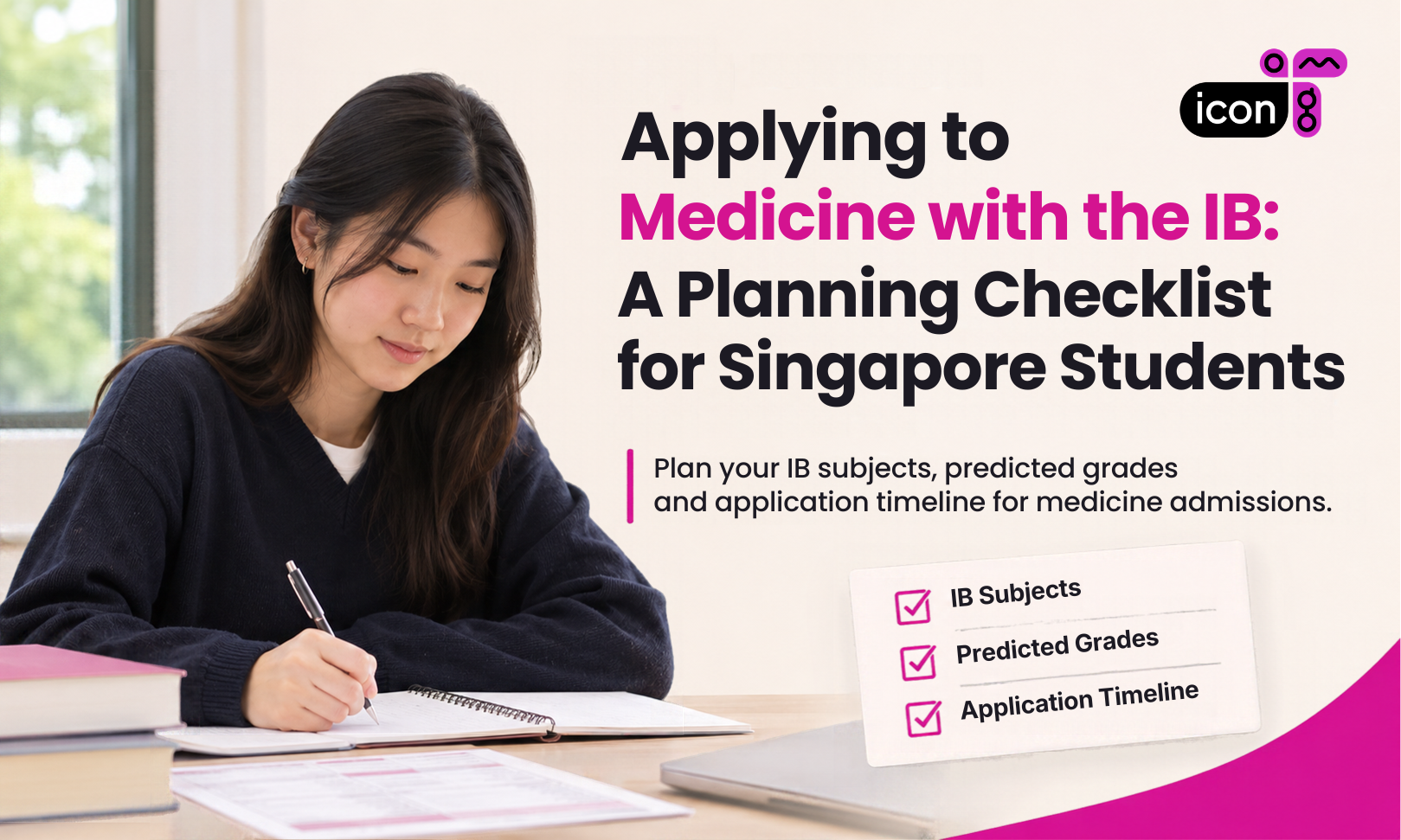
This guide explains how to compare medical school requirements, plan around your IB examination session and manage application tasks alongside schoolwork. It includes a university comparison, an IB-specific planning worksheet and a practical checklist.
Requirements and dates were checked against official university guidance in November 2026, using the 2027 entry cycle where available. Always verify the requirements for your intended intake before applying.
Which Subject Combinations Should You Verify?
Before estimating the IB score you need for medicine, check whether your subjects meet the entry requirements of your target universities.
Medical schools may assess both your overall Diploma score and your grades in particular HL subjects.
Total IB Points vs HL Subject Requirements
The IB Diploma is scored out of a maximum of 45 points.
Students receive grades from 1 to 7 across six subjects, with up to three additional core points available through Theory of Knowledge (TOK) and the Extended Essay (EE).
However, a high total score does not automatically satisfy every medical school's subject prerequisites.
Universities may specify:
- an overall IB points requirement;
- compulsory HL subjects;
- minimum grades in those subjects;
- admissions tests and interviews.
These requirements must be checked separately.
For example, a student with 42 IB points could still be ineligible for a medical program if they have not taken a required science subject at HL.
Which IB Subjects Do NUS and NTU Medicine Require?
For undergraduate medicine in Singapore, both universities specify the following subject combination:
HL Chemistry + HL Biology or HL Physics
NUS Yong Loo Lin School of Medicine
NUS requires a good pass in HL Chemistry and either HL Biology or HL Physics.
Applicants presenting actual IB results do not need a supplementary qualification such as UCAT under this entry route.
However, applicants using predicted IB results must meet additional requirements.
NTU Lee Kong Chian School of Medicine (LKCMedicine)
NTU requires a pass in HL Chemistry and either HL Biology or HL Physics.
Applicants must also take UCAT. Their applications are assessed using academic results and other selection components, including interviews for shortlisted candidates.
Both universities distinguish between satisfying subject prerequisites and being competitive for admission.
What If You Take HL Mathematics Instead of Biology or Physics?
Consider a student taking:
- HL Chemistry
- HL Mathematics
- HL English
This combination includes Chemistry and Mathematics at HL but neither Biology nor Physics at HL.
It therefore does not meet the stated subject requirements for NUS or NTU Medicine.
However, Oxford Medicine accepts HL Chemistry together with at least one of HL Biology, Physics or Mathematics.
This means the student meets Oxford's specified HL subject pairing, although they must still satisfy its other academic and selection requirements. Oxford also expects applicants to have an appropriate foundation in Biology, Physics and Mathematics.
The lesson: Check subject eligibility before comparing admission scores or deciding which admissions tests to prepare for.
How Do Requirements Differ by University?
There is no single set of IB requirements that applies to every medical school.
Some universities publish specific IB points and HL grade requirements. Others evaluate applicants through a combination of academic eligibility, admissions tests and competitive selection.
IB Medicine Requirements: University Comparison
The following comparison covers four universities relevant to Singapore students.
|
University |
IB academic requirements |
Other requirements |
|
NUS Medicine, Singapore |
Good pass in HL Chemistry and HL Biology or Physics. No fixed Medicine-specific total IB cutoff is stated in the published prerequisites. |
Medicine portfolio and Focused Skills Assessment (FSA) if shortlisted. Supplementary testing depends on whether actual or predicted IB results are submitted. |
|
NTU LKCMedicine, Singapore |
Pass in HL Chemistry and HL Biology or Physics. No fixed Medicine-specific total IB cutoff is stated in the published entry requirements. |
UCAT, personal statement, referee reports and Multiple Mini-Interviews (MMI) if shortlisted. |
|
University of Oxford Medicine, UK |
39 IB points, including core points, with 7, 6, 6 at HL. HL Chemistry plus at least one of Biology, Physics or Mathematics. |
UCAT and interviews for shortlisted applicants. |
|
UNSW Medicine, Australia |
For the relevant international school-leaver pathway, an academic rank equivalent to an ATAR of at least 96.00. |
UCAT ANZ at or above the 50th percentile, or ISAT with a minimum score of 165, plus an interview if shortlisted. |
This comparison is not exhaustive. Requirements depend on the intended intake and applicant category. Published minimums establish eligibility for consideration, not guaranteed admission.
Official university requirements can be checked through NUS Medicine, NTU LKCMedicine, Oxford Medicine and UNSW Medicine.
Is There One IB Score Needed for Medicine?
No. There is no universal IB score that guarantees entry to medical school.
For example, Oxford publishes an overall requirement of 39 points with specific HL grades.
NUS and NTU publish their subject prerequisites and selection requirements without stating one fixed Medicine-specific total IB points threshold on the cited pages.
UNSW uses academic-rank requirements for the relevant international applicant pathway. Its ATAR-equivalent threshold should not be treated as a fixed IB score without checking the university's accepted qualification conversions.
Therefore, questions such as "Is 37 a good IB score for medicine?" depend on the universities being considered.
An applicant must check:
- whether the overall score meets the university's published requirements;
- whether the required HL subjects and grades are satisfied;
- whether the applicant meets the admissions-test requirements;
- whether the qualification and examination session are eligible for the intended intake.
Meeting a minimum requirement does not guarantee an interview or an offer.
What Should Singapore Students Consider for UK and Australian Medicine?
For IB medicine applications to the UK, pay attention to the required HL combination, overall score, UCAT and UCAS application deadline.
For IB medicine applications to Australia, confirm the relevant international applicant pathway, accepted IB qualification, academic-rank requirements and admissions tests.
For example, UNSW accepts eligible international IB applicants through different application routes, including direct applications and the Universities Admissions Centre (UAC). The appropriate route depends on the applicant's circumstances.
Do not assume every medical school accepts the same admissions tests or follows the same academic calendar.
How Should Predicted and Final Results Be Handled?
For IB students, one of the most important application decisions is whether to apply with predicted grades or actual Diploma results.
This is particularly relevant because November and May IB examination sessions can lead to different application procedures.
NUS Medicine: November and May IB Examinations
NUS distinguishes between applicants who already have their IB results and those taking their final examinations later.
November 2026 or earlier examination sessions
Applicants use their actual IB results and authorize the IB to release their official transcripts to NUS.
For NUS Medicine, applicants using actual IB results do not need a supplementary qualification such as UCAT under this pathway.
May 2027 examination session
Applicants may apply using predicted IB results endorsed by their school.
However, NUS Medicine requires an additional accepted qualification.
The available routes include:
- UCAT (UK or ANZ); or
- a qualifying SAT/ACT and AP examination combination under NUS's specific requirements.
Applicants considering the second route should confirm the precise accepted tests and writing requirements with NUS before registering.
For the 2027 intake, applicants using predicted results must submit their school-endorsed predictions and required supplementary testing information by 17 February 2027.
They must also arrange for their final official IB results to reach NUS within the published deadline.
The full requirements are explained in NUS's IB Diploma admission guidance.
Important: Predicted grades alone are not sufficient for the NUS Medicine May 2027 IB application route.
NTU LKCMedicine: Check Your Examination Session
NTU follows a different policy.
For the 2027/28 admissions exercise, applicants sitting the May 2027 IB examinations are not eligible to apply to LKCMedicine.
This is because LKCMedicine does not accept predicted grades in place of the required final academic results for that intake.
The restriction is specific to certain NTU programs, including Medicine. It should not be confused with the university's general IB admissions procedures.
For eligible applicants, NTU requires actual academic results and a valid UCAT score.
Students planning to sit the May 2027 IB examinations should therefore not assume they can apply to both NUS and NTU Medicine for the same 2027 intake.
The restriction is stated in NTU's IB Diploma admission guidance.
Predicted Grades for UK and Australian Medicine
United Kingdom
For UK university applications, schools typically provide predicted grades when students have not yet completed their final examinations.
Universities consider these alongside other application evidence.
Applicants receiving conditional offers must subsequently achieve the required final results.
For example, an applicant targeting Oxford Medicine for autumn 2027 entry needed to complete the relevant UCAT and submit their UCAS application during 2026, even if their final IB examinations take place in May 2027.
Australia
Australian medicine admissions procedures vary by university.
UNSW allows eligible students to apply before their final school results are available, but it does not make Medicine offers based on predicted results alone.
Final academic results, the relevant admissions test and interview performance are required for selection.
The timing of the course's commencement is also important.
UNSW Medicine begins its 2027 academic year on 15 February 2027.
A student taking final IB examinations in May 2027 would not have those results before this start date. They should investigate a later feasible intake rather than assume all programs labeled "2027 entry" follow the same schedule.
How Do You Coordinate Schoolwork and Application Tasks?
Medicine applications often require students to manage several deadlines while completing demanding IB coursework.
An effective plan should begin with the intended entry year and work backward through the required assessments and submissions.
Understand Different 2027 Entry Timelines
The selected universities do not begin their academic years at the same time.
|
University |
Published 2027 entry milestones |
|
NUS Medicine |
IB applications: 16 December 2026–17 February 2027. Medicine portfolio deadline: 9 March 2027 for EBAS or 19 March 2027 for Standard Scheme, both at 11:00 AM Singapore time. |
|
NTU LKCMedicine |
IB applications: 15 October 2026–19 March 2027. Personal statement by 19 March 2027 and two online referee reports by 22 March 2027. |
|
Oxford Medicine |
UCAS deadline for 2027 entry: 15 October 2026, 18:00 UK time. The required UCAT testing period took place in 2026. |
|
UNSW Medicine |
International applications for the relevant 2027 routes: 30 November 2026. First-year Medicine begins 15 February 2027. |
These dates are specific to the 2027 cycle. Confirm deadlines for your qualification, applicant category and submission route.
For Singapore applications, the dates are published in the NUS admissions calendar, NUS Medicine portfolio schedule and NTU admissions calendar. The Oxford and UNSW dates are provided in their official Medicine guidance linked earlier.
What If a Deadline Has Already Passed?
For students researching medicine applications in November 2026, some requirements for 2027 entry have already passed.
For example, Oxford's 2027 Medicine application deadline was 15 October 2026, and the relevant UCAT testing period has ended.
Applicants who missed a required application or test deadline should check their available options with the university and consider preparing for a later intake.
Do not assume a required admissions test can be taken during the following year's university application window.
Step 1 — Complete Your IB Medicine Planning Worksheet
Use the following worksheet to organize your application plan.
|
Planning item |
Your information |
|
IB examination session |
November / May, with year |
|
HL subjects |
Your actual subject combination |
|
Target university and Medicine program |
University and course name |
|
Required HL subjects |
University's published subject prerequisites |
|
Overall academic requirement |
IB points or other accepted academic criteria |
|
Admissions test |
UCAT, UCAT ANZ, ISAT or another applicable test |
|
Predicted or actual results |
Which results the university accepts |
|
Application deadline |
Date for your qualification and intake |
|
Required documents |
Transcripts, references, portfolio or other submissions |
|
Next action |
Your most urgent outstanding task |
Complete a separate worksheet for each university rather than assuming the same information applies to all institutions.
Step 2 — Check Eligibility Before Planning Admissions Tests
Consider a student taking:
- HL Chemistry
- HL Mathematics
- HL English
The student is considering NUS, NTU and Oxford Medicine.
A preliminary subject check gives different results.
NUS Medicine: The student does not meet the stated HL Biology or Physics requirement.
NTU LKCMedicine: The student does not meet the stated HL Biology or Physics requirement.
Oxford Medicine: The student satisfies the stated combination of HL Chemistry and HL Mathematics, but must still meet the overall IB requirements, demonstrate the expected academic foundation and complete the required admissions process.
This example shows why the first task is verifying subject eligibility, not immediately registering for admissions tests.
Step 3 — Coordinate Applications With Your IB Workload
Divide your preparation into three manageable stages.
Early preparation
Check your HL subjects, identify eligible medical schools and confirm which admissions tests apply.
Discuss predicted-grade procedures and transcript arrangements with your IB coordinator.
Application period
Track deadlines, complete applications and arrange any necessary references, test scores and supporting documents.
Prioritize submissions that cannot be completed after the deadline.
Final examinations and results
Focus on IB examination preparation while monitoring university requests.
Arrange official transcript release and complete any outstanding conditions attached to an offer.
These stages are general planning guidance. Your actual schedule should follow the deadlines for your intended intake.
Step 4 — Review Your Priorities Each Week
A short weekly review can help prevent application tasks from interfering unnecessarily with schoolwork.
Ask yourself:
- Which IB assessments need my attention this week?
- Is an admissions-test or university deadline approaching?
- Do I need to contact my IB coordinator or a referee?
- Are any documents missing?
- What is the most important application task I can complete this week?
When school assessments become demanding, prioritize essential admissions deadlines and avoid adding unnecessary preparation tasks.
Final IB Medicine Application Checklist
Before submitting an application, confirm:
- My HL subjects satisfy each university's prerequisites.
- I have checked total IB points separately from HL grades.
- My examination session is eligible for the intended intake.
- I understand whether predicted or actual results are required.
- I have identified the correct admissions tests and testing windows.
- I know the correct application route and deadline.
- My school can provide the necessary references and predicted grades.
- I understand how official IB results must be released.
- I have checked any separate portfolio or interview requirements.
- My planned intake begins after I can meet the qualification requirements.
- I have coordinated application tasks with my IB workload.
For more detailed Singapore medical-school admissions guidance, explore Icon Education's NUS Medicine admissions guide and NTU Medicine admissions guide.
Always confirm the latest cycle-specific requirements before acting on information from an earlier admissions guide.
Final Takeaway
Understanding IB medicine requirements in Singapore involves more than achieving a strong overall Diploma score.
You need to verify the required HL subjects, the university's admissions tests, whether predicted results are accepted and when the course begins.
These considerations become especially important when comparing medical schools in Singapore, the UK and Australia.
A practical approach is to:
Check your HL subjects → compare entry requirements → confirm results and test rules → organize application deadlines
Use your IB Medicine Planning Worksheet to identify gaps early and build a realistic schedule around your coursework.
A clear plan will help you focus on universities for which you are eligible and prepare the required application evidence without overlooking important deadlines.
Build an application plan around your IB subjects and target universities.